CORRESPONDENCE FILE
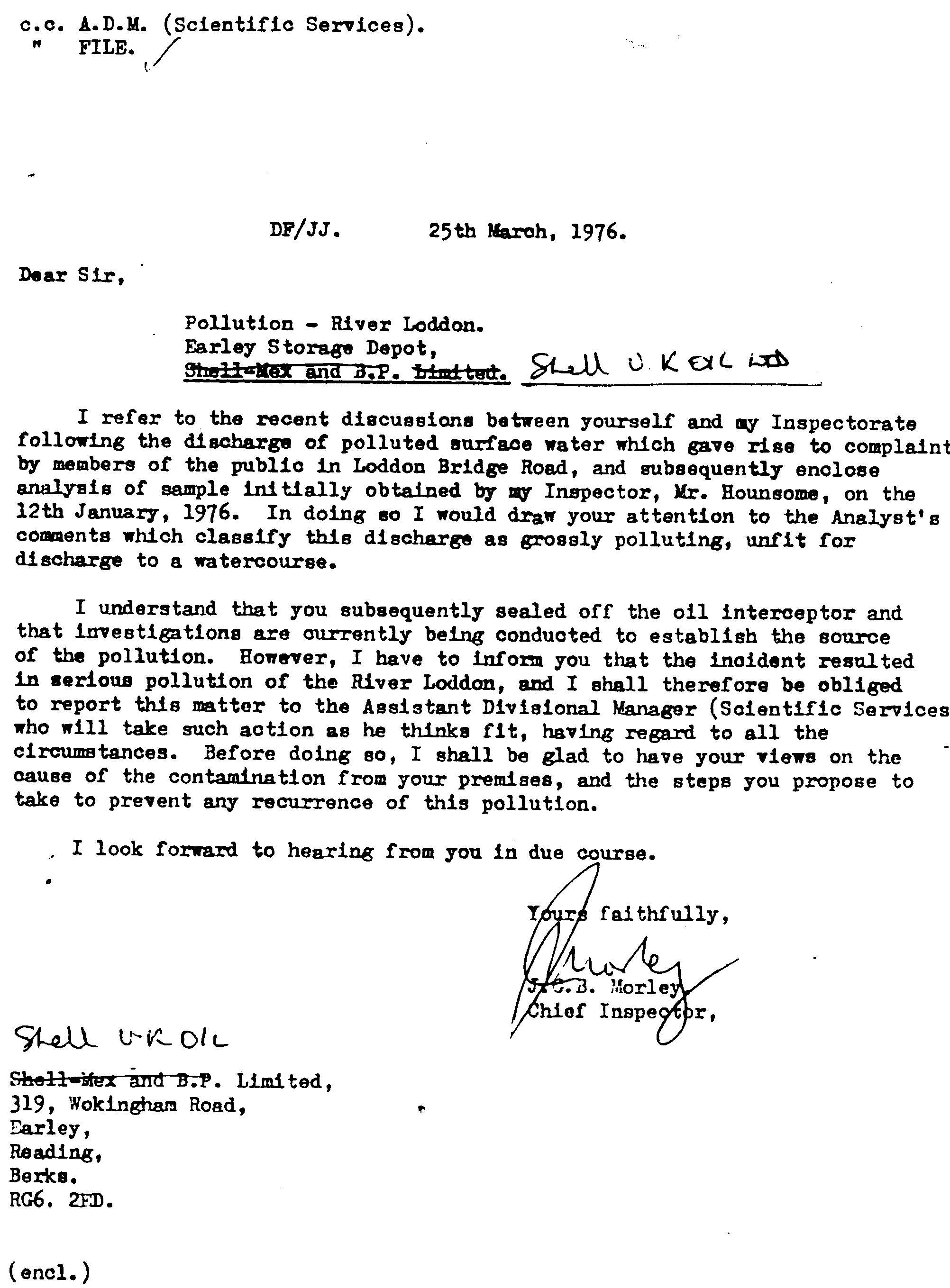
Letter from Thames Water Authority to Shell UK Oil: Pollution – River Loddon. Earley Storage Depot: 25 March 1976
Notification to Shell of “serious pollution of the River Loddon” from the Shell Earley “Storage Depot” seeking views on “contamination from your premises…”
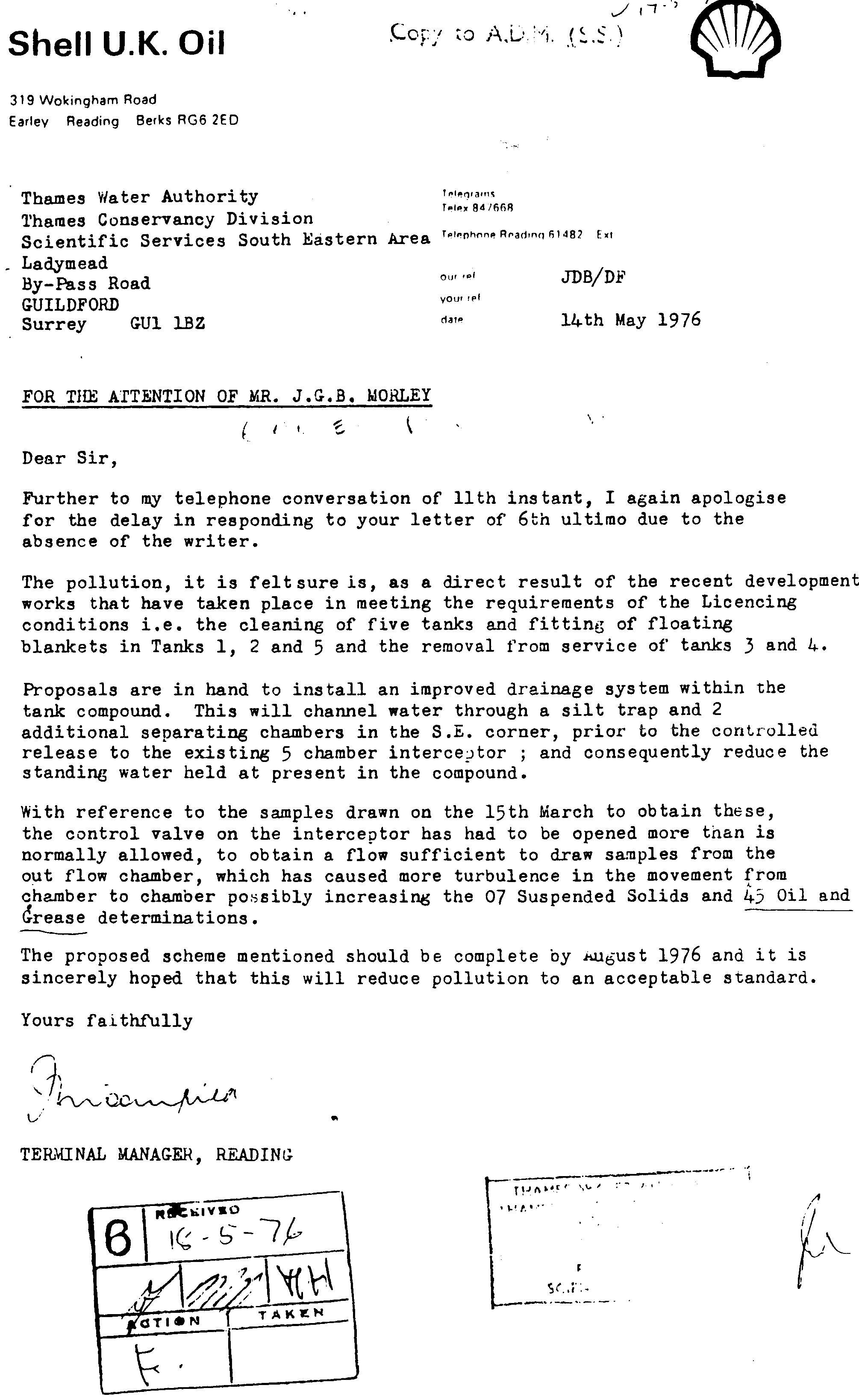
Reply letter to Thames Water Authority from Shell U.K. Oil: 14 May 1976
Shell reply blames pollution on new drainage which in the light of subsequent unauthorised discharge on adjoining property was apparently defective and illegal.
Decontamination letters from Shell to Mr R Collett, 8 Crompton Close, Earley Reading: Nov/Dec 1993
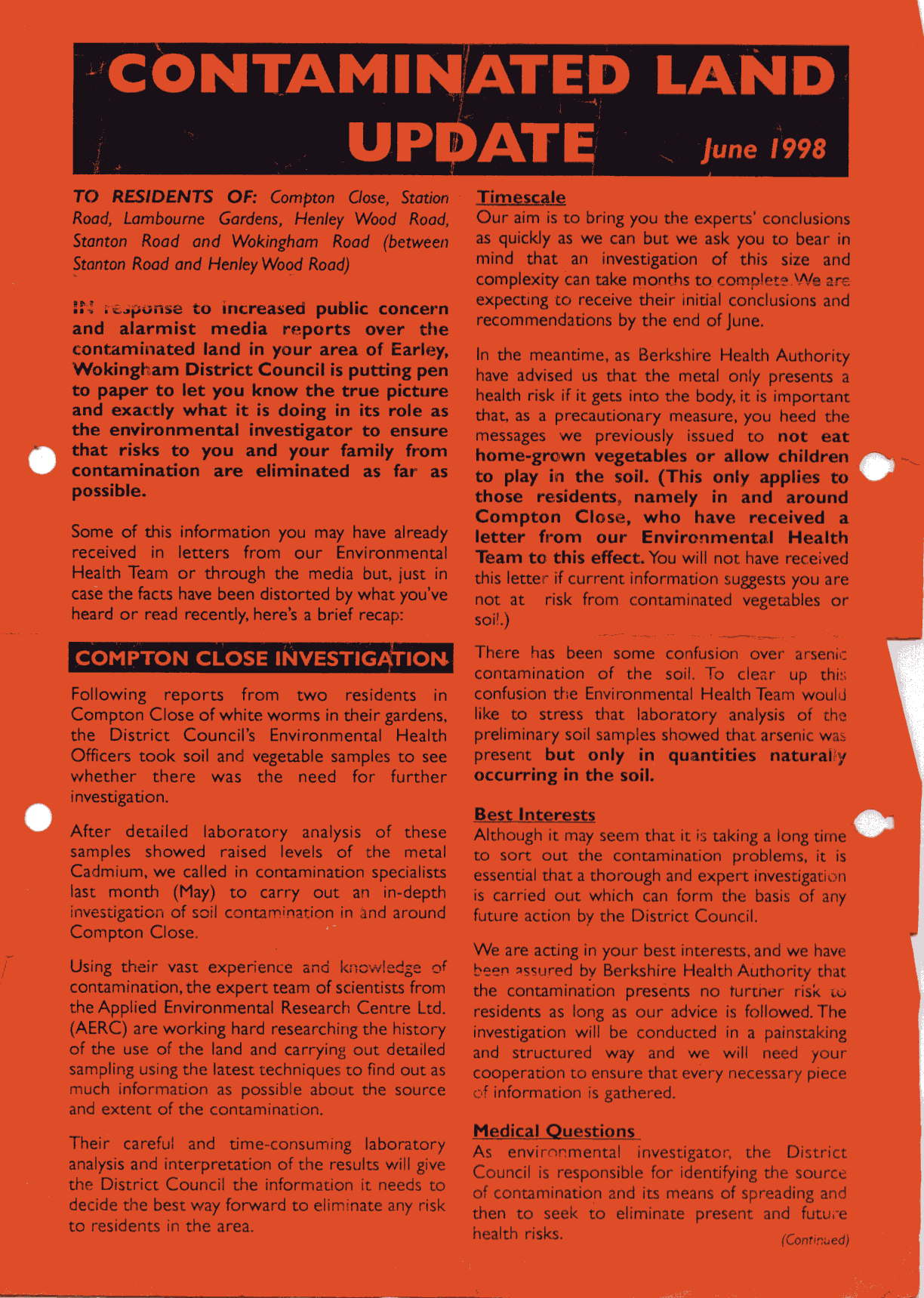
Letter from Shell announcing plans to “decontaminate” the Shell site at Earley prior to pending sale of the property. Further letter contains an apology from Shell “if our letter came as somewhat of a shock”. Offers reassurance over decontamination. It is interesting to note this is the “Richard Collett” interviewed in “The Bunker” programme when he described noticing “buried empty rooms” at the time when contractors were removing contaminated soil from the site. Apparently the “decontamination” was not satisfactory because at least one further “decontamination” was subsequently carried out. The site was also decontaminated after a chemical fire which according to reports at the time, included an explosion. None of the decontaminations apparently prevented the leakage of pollution/radioactivity on to ajoining property.
Letter to Mr Fox from Wokingham District Council confirming contamination of Shell Site: 22 December 1993
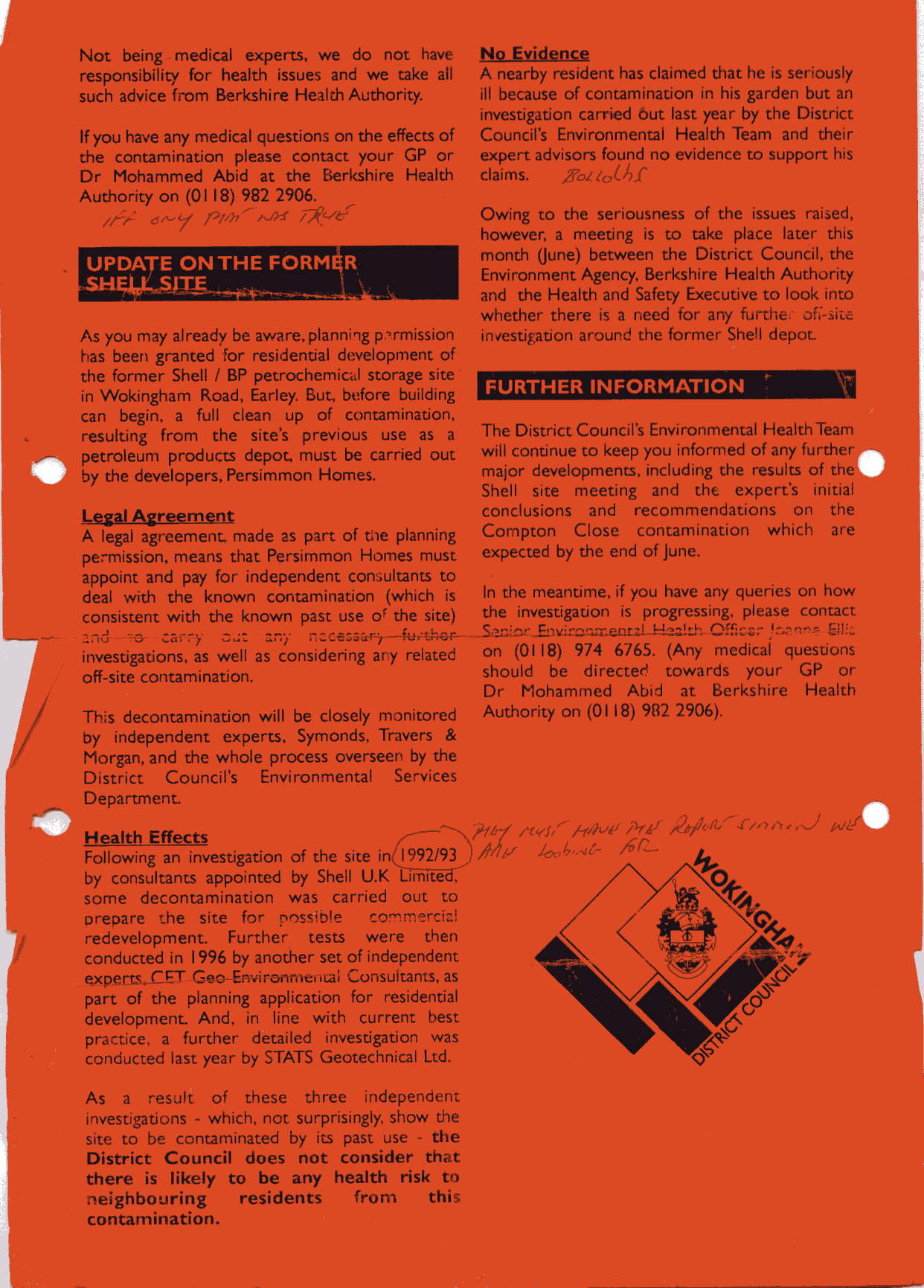
Letter says results of an independent survey “showed contamination, within the site boundary, by volatile inorganic hydrocarbons” and that “more heavily contaminated soil is being removed from the site…” Also says: “Samples were taken at the site boundary, but these showed no evidence of contamination, and so I can conclude that there is no risk of contamination of your property or any others adjoining the site.” Apparently the decontamination process was inadequate because, as previously indicated, at least two further decontamination processes had taken place at the site but none apparently prevented leakage of radioactive contamination. To be fair to the contractors involved, none were as far as we know, advised of any nuclear/radioactive history of the site.
Selection of correspondence with Shell Legal Division from 1995
GOOD NEIGHBOUR SHELL
Shell General Counsel Richard Wiseman blames Thames Water for a broken sewer resulting in discharge on Mr Fox’s garden, before shifting position. Eventually, while denying responsibility for contamination, Shell agrees to inspect and clean the drain. In a letter dated 26 October 1995, Shell admits that it does not “dispute the analysis of the samples taken from the drain by your expert and Thames Water” but continues to deny that “any contamination in your garden is the responsibility of this Company…” In a letter to John Redwood MP, Wiseman claims that Shell is helping Mr Fox on a “good neighbour basis by arranging for the drain to be cleaned and inspected at our expense while the legal situation is clarified.” This was an unfortunate comment bearing in mind that poisoning people as a byproduct of a commercial enterprise hardly falls within the definition of being a “good neighbour”. Shell has a track record of contaminating the environment and has paid huge fines for so doing. The Wikipedia record shows that Shell is a deadly neighbour, not a good one.
From Wikipedia: Royal Dutch Shell Environmental Issues:
Release of chemical pollutants at Shell Texas Deer Park complex
Emission violations at Shell Martinez refinery in California
Environmental infringements by Shell in Louisiana
Groundwater contamination by Shell in USA
Unauthorised venting and flaring of gas by Shell in USA
Shell Pipeline rupture in Washington
Environmental law infringements in Brazil
Refinery contamination in Texas
Oil Refinery in Durban
US Clean Air Act violations
Emission violations at Shell Wood River Refinery in Illinois
Shell settles Martinez Refinery dumping suit for $3 Million
Shell fined $19.75 million for oil spill from Martinez Refinery
Explosion at Shell Louisiana refinery
Pollution at Rocky Mountain Arsenal, Denver, Colorado
Selection of correspondence with Shell Legal Division 1996
Dr G Lethbridge of Shell’s Thornton Research Centre (now dealing with such matters at Shell Global Solutions) becomes involved. This suggests a serious concern by Shell at what was going on at Earley.
Report from Clayton Environmental Consultants plus associated correspondence with Shell Legal Division: March/April 1996
Clayton Environmental Consultants were present when during the cleaning and inspection of the drain as arranged by Shell and confirmed in their report that there was an oil discharge from the pipe which appeared fractured/open jointed at two locations. Subsequent letter from Shell legal division notified Mr Fox of Shell’s intention to repair the drain.
Selection of correspondence with Shell Legal Division 1997
Mr Fox writes to Shell saying he has received notification that a planning application has been made to build 42 houses on the Shell site. He also complained about the death of trees in his garden from “clear contamination”. Wiseman replies on 2 May saying “your horticultural problems cannot be attributed to escape of product from this Company’s premises.” On 16 May Wiseman sends a letter headed “CONTAMINATION AT 337 WOKINGHAM ROAD READING”. The letter contained an offer which was not made on a “without prejudice” basis to carry out work on the drain by inserting a sleeve. Instead the offer was made on the basis that no further claims would be brought against Shell. Mr Wiseman seemed understandably keen to draw Mr Fox into the agreement which, for the cost of a modification to a drain, would have relieved Shell of all future liability. Peanuts compared with a potential claim by Fox arising from contamination by toxic poisons or undeclared radioactive materials.
Ray Fox correspondence with Shell Legal Division in Nov/Dec 1997 and Feb/March 1998 relating to a fire at the Shell Depot in Earley, Reading in 1986
Shell legal division confirms that in 1986 a fire took place at the Shell Terminal in Earley. A Shell letter dated 5 December 1997 revealed that the site was “remediated” (decontaminated) based on “target contamination levels”. The following are extracts from the letter Mr Fox sent to Wiseman on 25 February 1998:
1) With regard to the chemical fire ( confirmed by your Mr Files letter of 7/11/1997 ref;– UKLG/\ 1!S94F) the subject of the follow up article is the production of large quantities of those highly documented mutagenic and carcinogenic compounds DIOXINS and PAHs which were an inevitable consequence of this type of fire.
2) The question of why no action was taken to inform local residents of the possible horrendous medical problems that could result from contact contamination from these compounds that are a proven cause of cancer and genetic abnormalities such as babies being born with limbs or organs missing. These effects are extremely well documented world wide and reference to the literature and reports of the US government’s Environmental Protection Agency, the US Department of Health, US Toxic Substances Registry and the World Health Organisation’s long term study of Sevcsco will all confirm this.
3) With reference to your consultants Fairhurst’s report post remediation April 1994, PAR contamination was confirmed in the area of the fire and in other parts of the your former Earley site.
5) The question of why, given that the PAH contamination recorded in the Fairhurst report of April 1994, not one single test was taken by CET in September 1996 in area 4b and this is confirmed in their report that was submitted to WOC with Persimmon’s planning application for your former Earley. The fact that the PAH contamination was known and recorded at woe raises the question as to how planning consent for housing on tills site could possibly have been granted.
Mr M H Files replied on behalf of Wiseman, side-stepping providing a reply to the vitally important issues raised in Mr Fox’s letter. Files informed Mr Fox that Shell had sold the contaminated site to Persimmon Homes and cold-bloodedly stated: “Shell no longer has any interest in the land” (or apparently the dire medical consequences to past and future households in the area arising from the long term contamination).
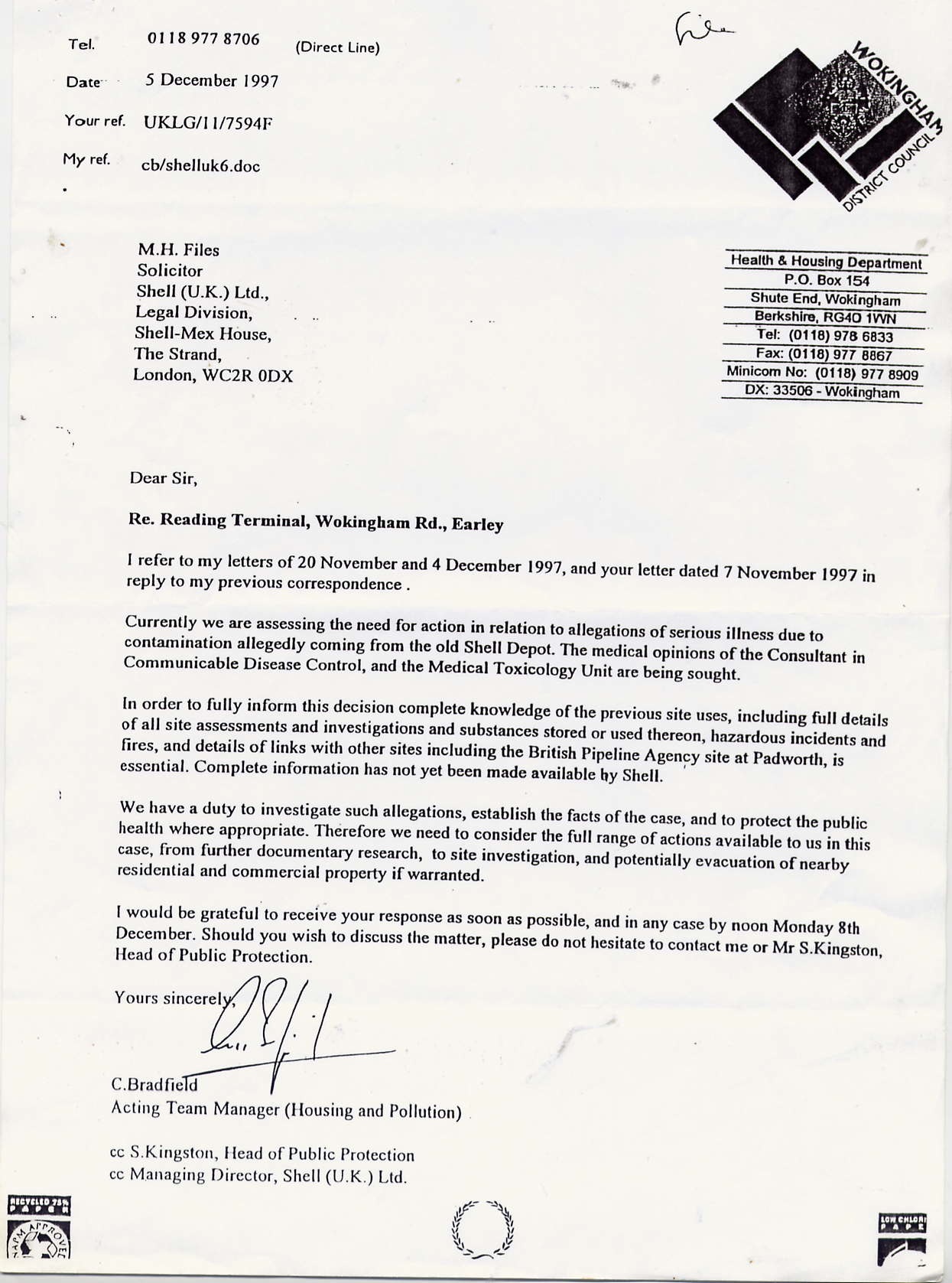
Wokingham District Council Letter to Shell Legal Division: 5 December 1997
Council seeks information about complete knowledge of previous site uses including all substances stored or used thereon. Shell did not disclose that any nuclear/radioactive material or activity was connected with the site.
Letter from Cllr David Swindells to Gillian Norton, Chief Executive, Wokingham District Council: 5 June 1998
Letter mentions public concern over site contamination issues and expresses hope that the Council will not authorise Persimmon Homes to build on the site until contamination issues resolved.
Letter from MH Files, Shell Legal Department: 3 October 1998
Letter confirms fire at the Shell terminal in 1986. It also refers to the defective drain pipe as being “our connecting pipe”. This is directly at odds with the denials and attempted buck-passing by Wiseman in earlier correspondence when Wiseman said that the pipe belonged to Thames Water. Mr Files was being economical with the truth when he indicated in his letter that Shell had been the site owner since 1976, yet failed to disclose Shell had been the co-owner of the site for many years earlier, when the activity which involved radioactive material may have occurred. We note that the letter contains admissions of a leaking drainage pipe running across Mr Fox’s garden and that contamination levels were above threshold in some areas. When Mr Files referred to “remediation”, was he using this term as a preferred alternative to “decontamination”?
Letter from Cllr David Swindells to Director of Community Services, Wokingham District Council: 20 July 1999
In this letter Cllr Swindells mentions a letter from Woodley Social Services recording that Shell had expressed concerns that the children of Mr & Mrs Fox were at risk, the inference being that they were at risk of being harmed due to the action of their parents. This was of course a very serious allegation.
Letter Deputy Town Clerk, Earley Town Council, to Mr & Mrs Ray Fox: 25 February 2000
Extracts:
As you are aware, at the time the original planning application was submitted by Persimmon Homes, the Town Council expressed its doubts about the suitability of the site for residential development, not only because of the former use of the site, but also from the high-voltage power cables which cross it. We were advised that the land would be cleared of contaminants…”
…and I have been asked to re-affirm that, if the Town Council were asked to consider a similar Planning Application today, they would remain of the opinion that it should be refused.
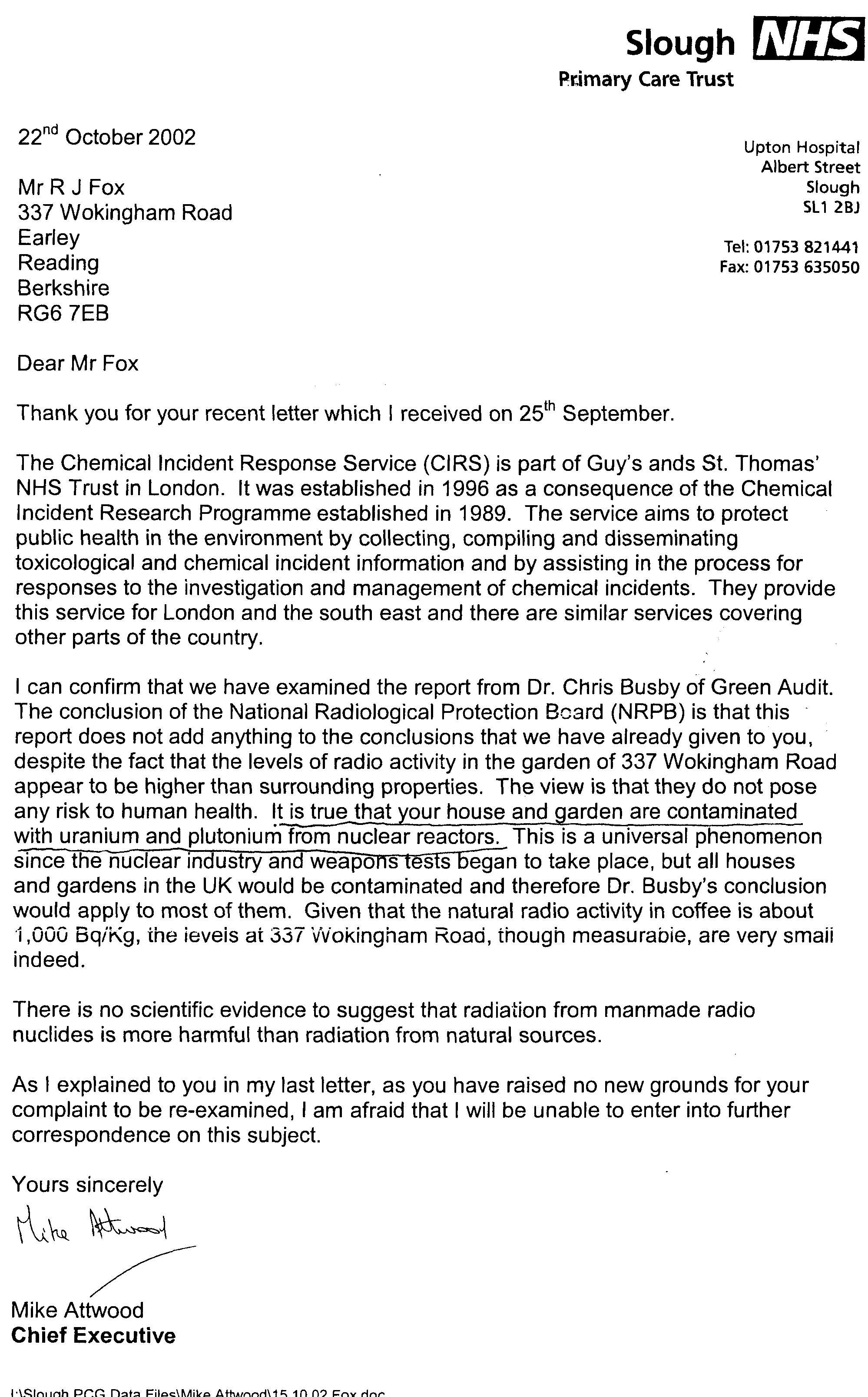
Letter to Ray Fox from Chief Executive of Slough NHS Primary Trust: 22 October 2002
NHS Primary Health Trust Chief Executive Mike Attwood states: “It is true that your house and garden are contaminated with uranium and plutonium from nuclear reactors.” He goes on to claim: “This is a universal phenomenon since the nuclear industry and weeapons tests began to take place.” Most of the UK population might find his statement to be rather alarming.
Letter to Ray Fox from Richard Wiseman, Shell UK General Counsel: 16 March 2004
16 March 2004
Dear Mr Fox
Thank you for your email of the 10th March. No, you cannot have copies of the correspondence in question. Since you constantly threaten litigation and indeed on several occasions have engaged firms of solicitors and referred to advice recently taken from American lawyers, the correspondence in question is clearly privileged.
I am afraid you have completely misunderstood the material you have obtained. Shell has never been involved in “atomic” or “nuclear” research at the Thornton site or elsewhere in the U.K. Between 1953 and 1966 it conducted research for the U.K. Atomic Energy Authority. The research was only ever concerned with developing lubricants for nuclear power plants. It involved subjecting lubricants to controlled emissions of low-level Gamma radiation in a small secure purpose built laboratory at Thornton. The work was conducted strictly in accordance with the Radio Active Substances Acts of 1948 and 1960 and other relevant legislation. The site was properly registered and regularly inspected. We have nothing to hide – we have never made a secret of this research programme. Indeed, the work was described in the publicly available brochure “50 Years of Thornton Research Centre” which was produced in 1990.
Yours sincerely
Shell International Limited
Richard Wiseman
U.K. General Counsel
Green Party Chairman’s letter to UK Government Minister, Nick Raynsford MP: 9 July 2004
EXTRACTS
The Green Party has become aware of the following assertions relating to Mr Ray Fox, of 337 Wokingham Road, Reading, Berkshire. Ray Fox lived until recently in Earley, near Reading, Berkshire.
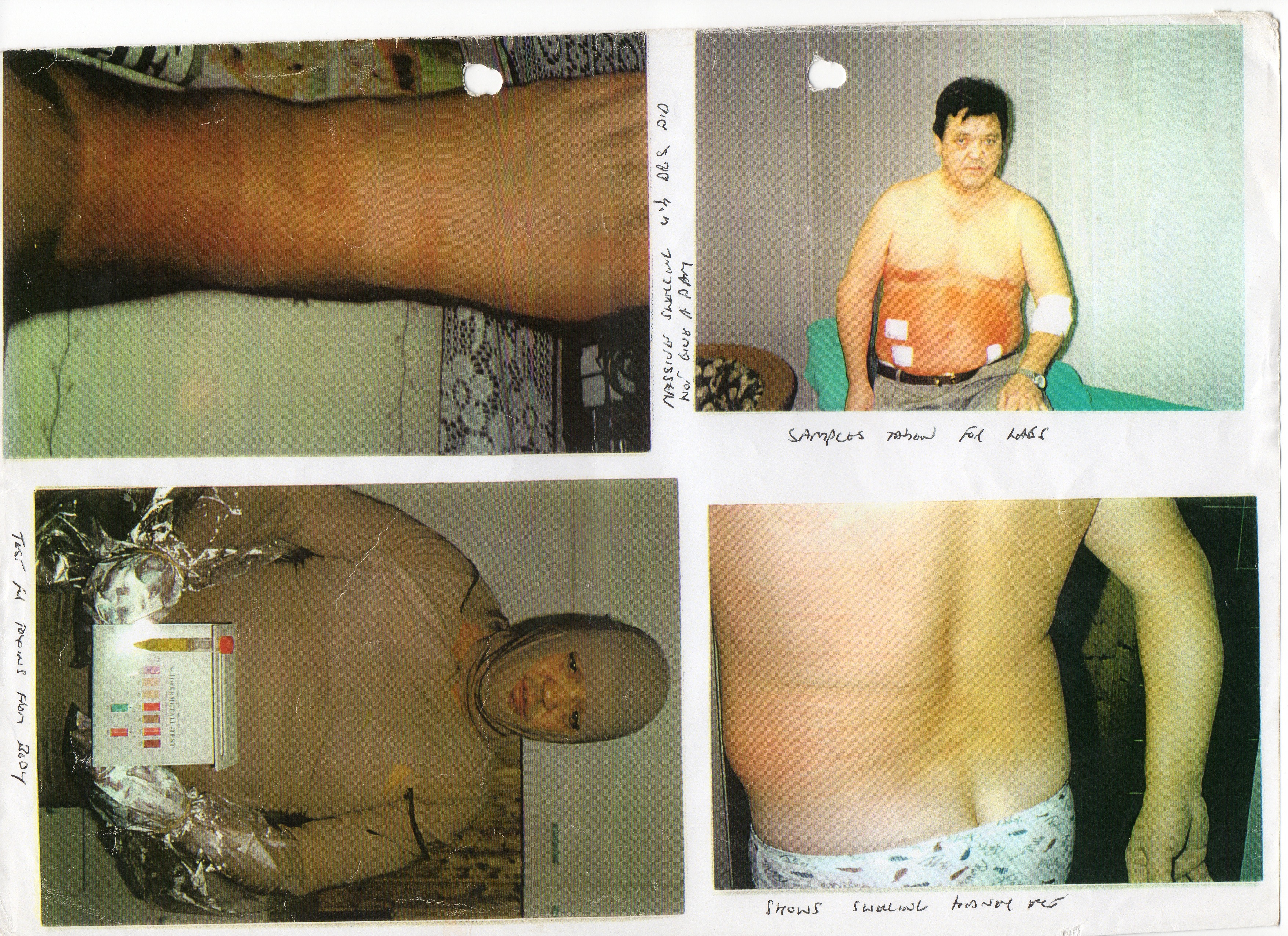
In the mid 1990s he dug up a drain at the bottom of his garden to clear a blockage which was flooding his garden. The land drain crossing the corner of his property was blocked with some tarry black material which Ray cleared away. Shortly after this he became seriously ill. His body became covered in what
appeared to be burns and blisters.
The symptoms appeared to be those of radiation poisoning. Thus began several years of struggle to obtain an explanation for his illness and its origin, a struggle that has slowly revealed elements of what appear to be a most extraordinary cover-up – a secret underground atomic research site operated in Reading in the 1960s by the Shell Oil Company as part of a research effort into the development of atom bombs. Parts of the story have been revealed in newspaper articles and on television, but Dr Chris Busby, of the Green Party has visited the site on two occasions and made radiation measurements. As you will know, on 25th Nov. 2002 Dr Chris Busby and Caroline Lucas MEP had a meeting in Brussels with Stephen Kaiser of the ED Radiation Protection unit to demand that they investigate the situation.
The facts appear to be as follows. Following his contamination and illness, Ray discovered that the drain he had unblocked was an illegal connection to the public land drain to the River Loddon and was apparently draining material from a Shell ‘oil depot’ at Earley, which had existed on a site at the bottom of his garden until the 1980s. After the closure of the depot, the land remained derelict until acquired by a developer in the late 1990s when it was ‘remediated’ by removing a metre of topsoil and replacing it with fresh topsoil. A new housing estate was built on the site and people now live there.
According to the results of tests mentioned in the letter…
“…the Plutonium levels in Ray’s house were up to 60 times higher than would be expected.”
The letter goes on to state: –
“What supports the argument that there has been contamination from a reactor or fissionable nuclear bomb material is the ratio of Uranium-238 to Uranium-235. Although the absolute levels are not high, this ratio is an unmistakable fingerprint for material from a reactor or a bomb core. “
Letters from Dr Caroline Lucas MEP to Stephen Kaiser, Head of the DG Environment Radiation Protection unit (EU Aurthority) and to the Patient Advice & Liaison Service, Reading.
Shell DEFENCE to Action in the High Court Justice Queens Bench Division Case No. HQ06X01271: BETWEEN: Raymond James Fox & Others (Claimant) And Shell U.K. Limited ( Defendant): 31 May 2006
Shell files its defence in relation to High Court proceedings brought against Shell for personal injury and consequential loss by Ray Fox & Others arising from alleged escape of noxious radioactive substances from the Shell Earley Terminal.
Shell quickly brought to the Courts attention that Mr Fox was made bankrupt on 12 February 2001. The bankruptcy arising from a personal guarantee relating to a directorship of a building company has been described in an article as being “highly dubious”. Mr Fox says that a bankruptcy order was made against him while he was abroad receiving specialist medical treatment from radiation exposure. He claims that a forged document was used to obtain the order and that his offer to pay the claimed sum of around £7,000 was declined. He also points out that the order made him bankrupt on an indefinate basis. The bankruptcy does indeed appear dubious to say the least.
Shell denied operating a “nuclear facility” at Earley and that any “radioactive material” was transmitted to Fox’s home. However, Shell did not deny in the defence document that radioactive material was stored at the terminal.
Perhaps even more significantly, Shell said that it would:
“admit that if, contrary to the above, the Claimants prove that the Defendants used or stored radioactive material at the Earley Terminal and that this radioactive material was transmitted from the Earley Terminal to the Claimant’s home then this would represent the breach of relevant duties owed by the Defendants to the Claimants as adjoining occupiers and/or persons living in the vicinity of the Earley Terminal.”
Unfortunately Shell succeeded in blocking the litigation. Prosecution of the claim on a timely basis had been made difficult if not impossible by the bankruptcy order, the associated lack of funds and the continuing ill health of Mr Fox. In blocking the action, Shell also succeeded in preventing the UK Atomic Energy Authority from having to supply relevant documents to Mr Fox in accordance with an application he had made to the courts. Very powerful forces were at work, including almost certainly the British Intelligence Services with whom the UKAEA and Shell have had a long association.
Email Correspondence with Shell November 2008
 nuclear-contamination-cover-up