Press articles covering Shell involvement in Al-Yamamah corruption scandal

Press articles covering Shell involvement in Al-Yamamah corruption scandal

Extract from MEED Middle East Economic Digest article published 17 May 2002 under the headline: Al-Yamamah weathers the changes. (BAE). (Al-Yamamah project remains at the heart of the UK trade drive in Saudi Arabia)

The largest contract ever awarded to a British company, the Al-Yamamah project remains at the heart of the UK trade drive in Saudi Arabia, generating a substantial portion of Britain’s export earnings from the largest economy in the Arab world. Although past its peak, Al-Yamamah still generates at least [pounds sterling] 100 million of sales a year. Contract payments are made through an oil barter arrangement involving BP and the Royal Dutch/Shell Group.

http://www.accessmylibrary.com/coms2/summary_0286-25436298_ITM

Extract from The Daily Telegraph published 19 August 2006 under the headline: “BAE lands arms deal for a new generation”

The oil-for-arms basis of the first deals only served to add to the mysterious workings of Al-Yamamah. BAE was “paid” in oil produced by Saudi outside its Opec quota and sold in the market by BP and Shell. The switch from oil to cash as the basis for the third deal has been influenced by a Saudi anti-corruption drive and a recognition that the slush funds associated with other Saudi arms contracts have helped finance terrorism. There is also a recognition that Al-Yamamah – which means The Dove – is hardly appropriate for defence contracts. There is nothing “dovish” about destructive weapons.

http://www.telegraph.co.uk/finance/2945759/BAE-lands-arms-deal-for-a-new-generation.html

Extract from The Times article published on 21 February 2007 under the headline: “Al-Yamamah an echo of 1980s sleaze”

“The first two al-Yamamah deals were complicated oil-for-arms arrangements that cost Saudi Arabia a certain number of barrels of oil a day. This oil was transferred to BP and Shell, which in turn paid the value of the oil into an escrow account from which BAE received its money.”

http://business.timesonline.co.uk/tol/business/article1415469.ece

Extract from The Guardian article published on 7 June 2007 under the headline: The al-Yamamah deal “Al-Yamamah is Britain’s biggest ever arms deal.

The agreement – its name means “the dove” in Arabic – has kept BAE afloat for the last 20 years, bringing around £40bn of revenue.” “Al-Yamamah has been controversial for many reasons. Within weeks of the deal being signed in 1985, allegations of corruption surfaced. Those allegations have never gone away; in December 2006 the government terminated the Serious Fraud Office investigation into claims that BAE had paid massive bribes to Saudi royals.”

http://www.guardian.co.uk/world/2007/jun/07/bae15

Extract from Financial Times article published 8 June 2007 under the headline: “Barter fund used to pay commissions to middlemen”

Al-Yamamah is covered by government-to-government contracts between Saudi Arabia and Britain, which the British government and BAE insist are confidential. At its heart was a barter arrangement under which the Saudis delivered oil to BP and Royal Dutch Shell, which sold it and deposited the proceeds in an escrow account at the Bank of England. Payments from this account required signatures from officials of both Saudi and British governments. From this account, BAE was paid in stages as it completed project milestones. It used some proceeds to pay commissions to middlemen who had helped facilitate the transaction.

http://www.ft.com/cms/s/0/579364ac-155c-11dc-b48a-000b5df10621.html

Extract from Financial Times article published 2 July 2007 under the headline: Al-Yamamah deal: the Saudi foreign policy connection

The arrangement, at least initially, involved a special account controlled by the Saudis, at the Bank of England. This would receive funds from the sale of Saudi oil lifted and sold by BP and Royal Dutch Shell, which took a commission. Press reports in 1996 suggested this exact arrangement changed – but over nearly two decades, tens of billions of dollars were directed through it.

http://www.ft.com/cms/s/0/c8286b10-2833-11dc-80da-000b5df10621.html

Extracts from The Times article published 11 April 2008 headlined: Margaret Thatcher ‘ordered bugging of prince’

Al-Yamamah was initially an oil-for-arms trade. BAE supplied Tornados to the Saudis and they transferred oil to Shell and BP. These companies would pay for the oil by moving money into an account held by the Bank of England. The Ministry of Defence then paid BAE from there.

http://www.timesonline.co.uk/tol/news/politics/article3724416.ece

LINK TO THIS SECTION AS A SEPARATE WEBPAGE

Declassified documents from UK National Archive revealing secret dealings of Royal Dutch Shell with the UK Atomic Energy Authority

Declassified documents from UK National Archive revealing secret dealings of Royal Dutch Shell with the UK Atomic Energy Authority

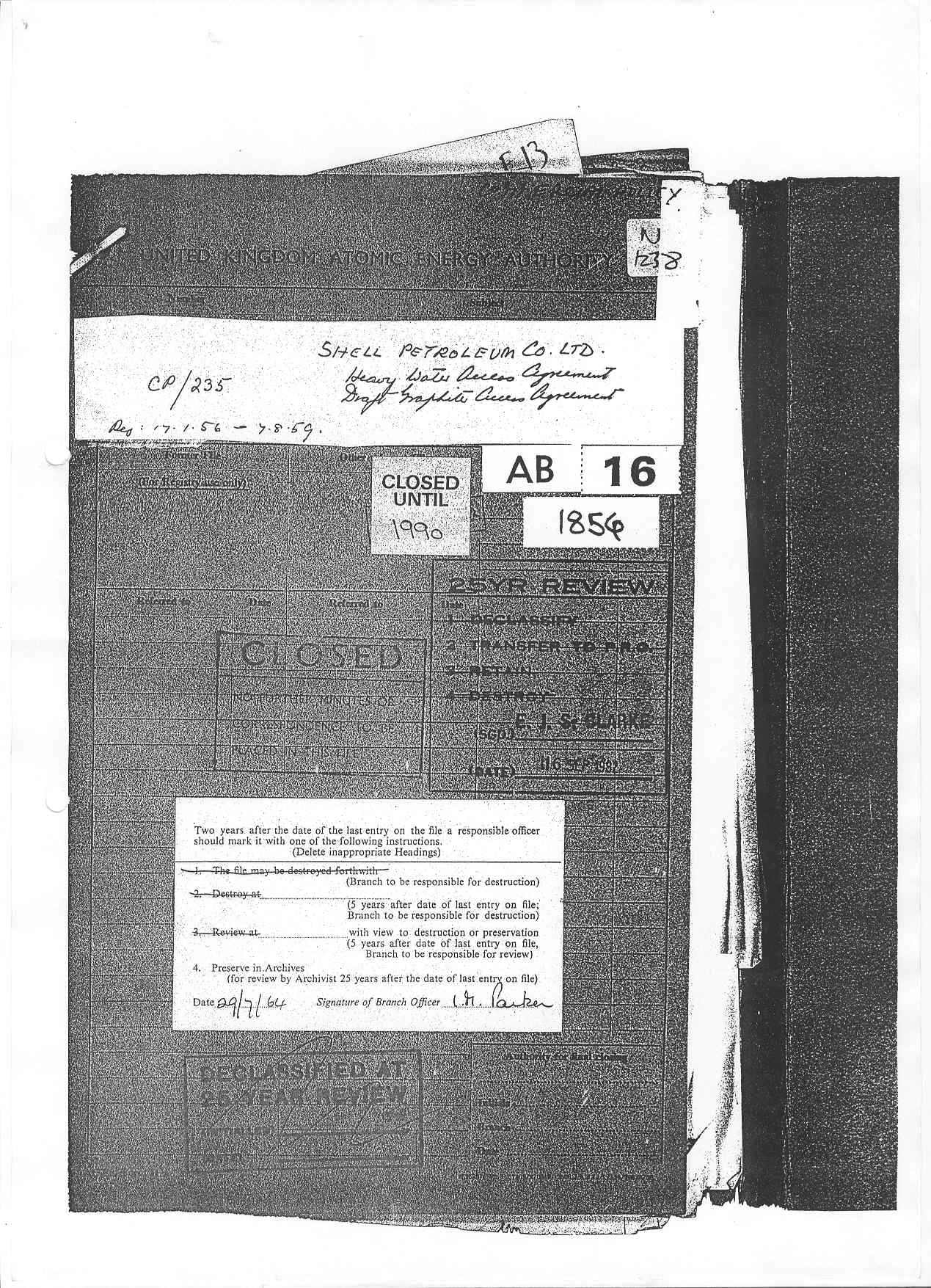
UNITED KINGDOM ATOMIC ENERGY AUTHORITY (UKAEA) DOCUMENT FOLDER CONTAINING DOCUMENTS DECLASSIFIED AT 25 YEAR REVIEW: Handwritten on cover: “SHELL PETROLEUM CO. LTD Heavy Water Access Agreement”: “Draft Graphite Access Agreement”

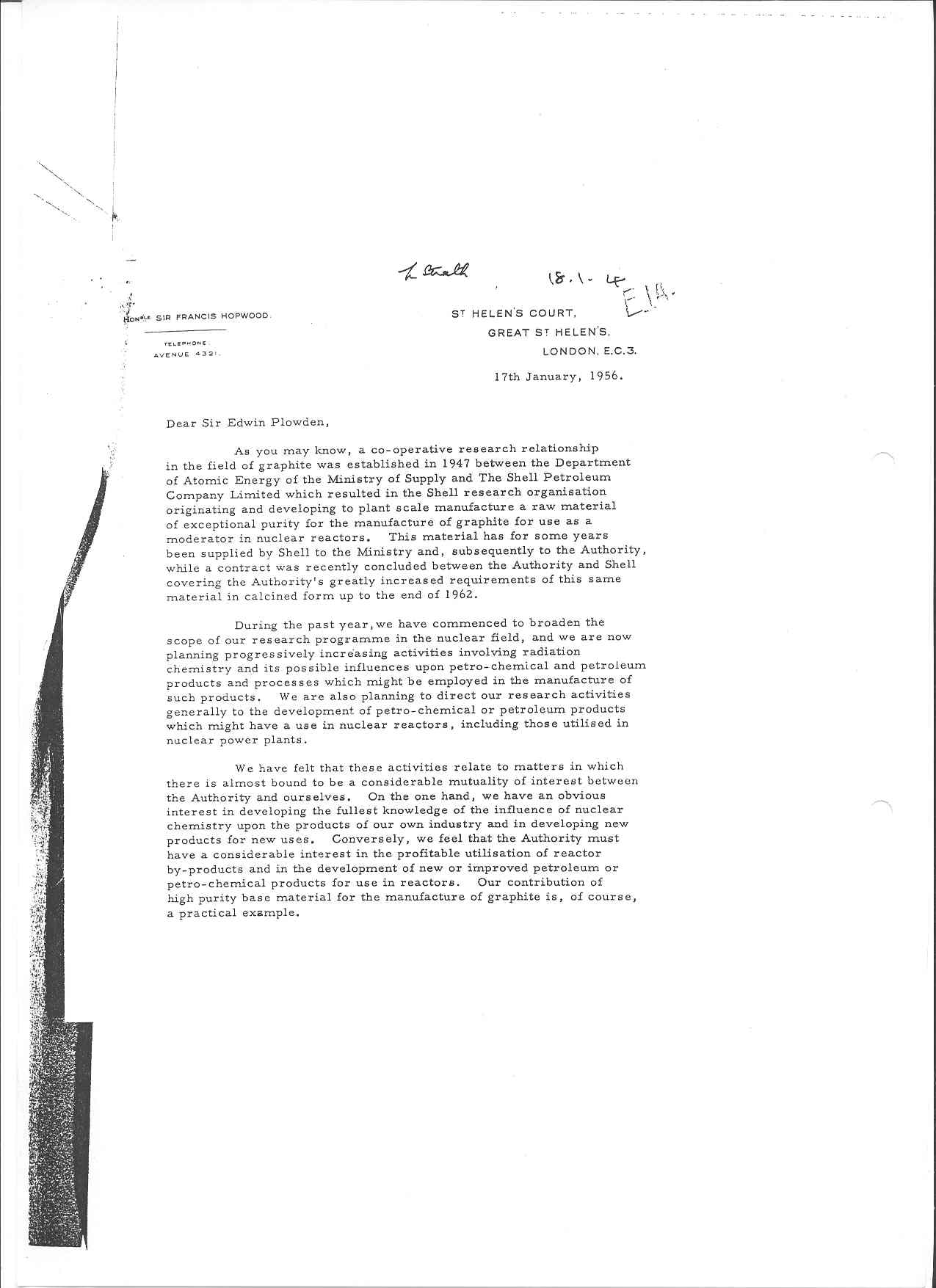
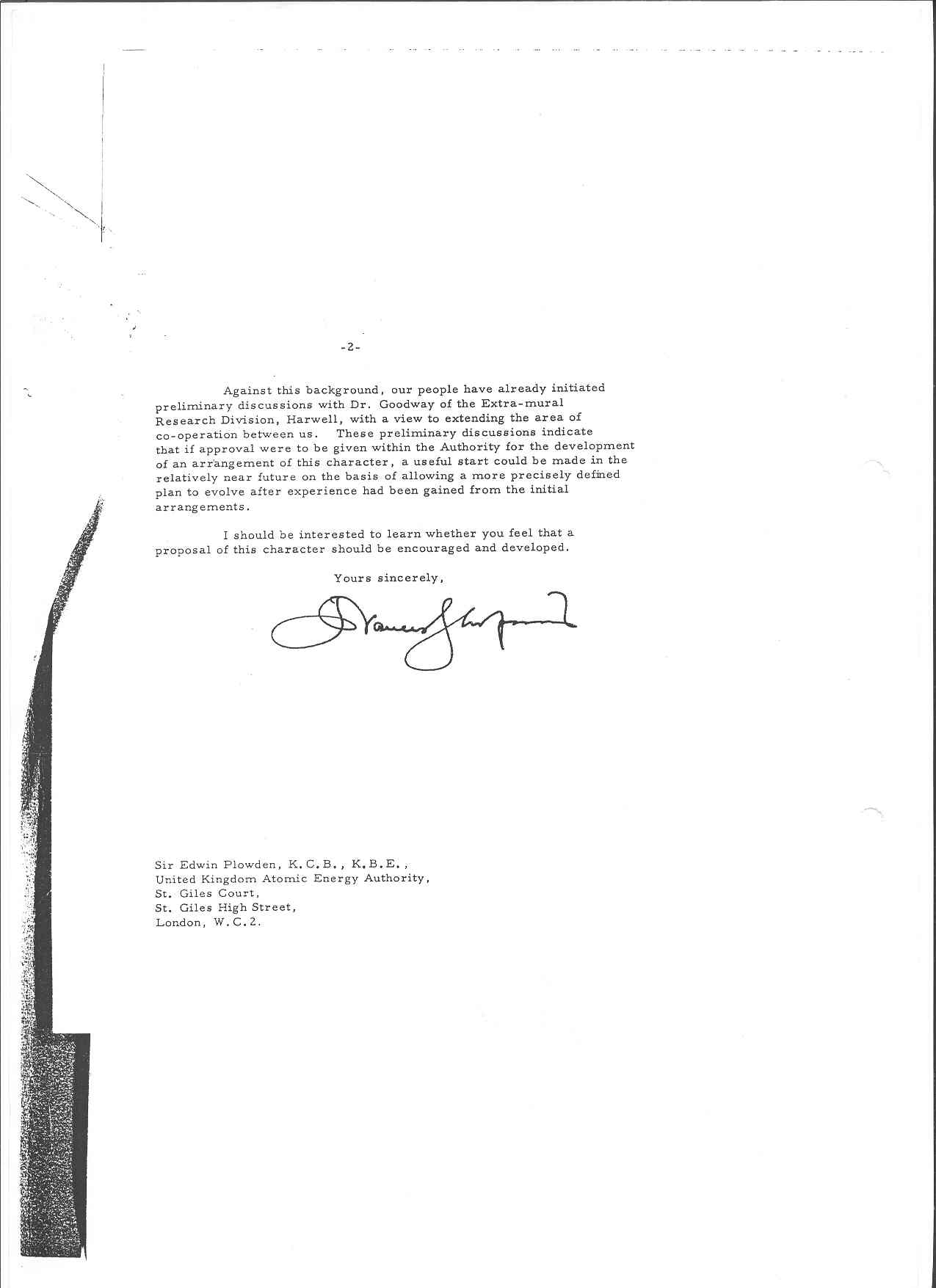
Letter from Shell Chairman Sir Francis Hopwood to Sir Edwin Plowden, Chairman of UKAEA: 17 January 1956: Announces Shell’s ambition to broaden the scope of its “research programme in the nuclear field”: (see Page 1 & Page 2 below:

Page 1

Page 2

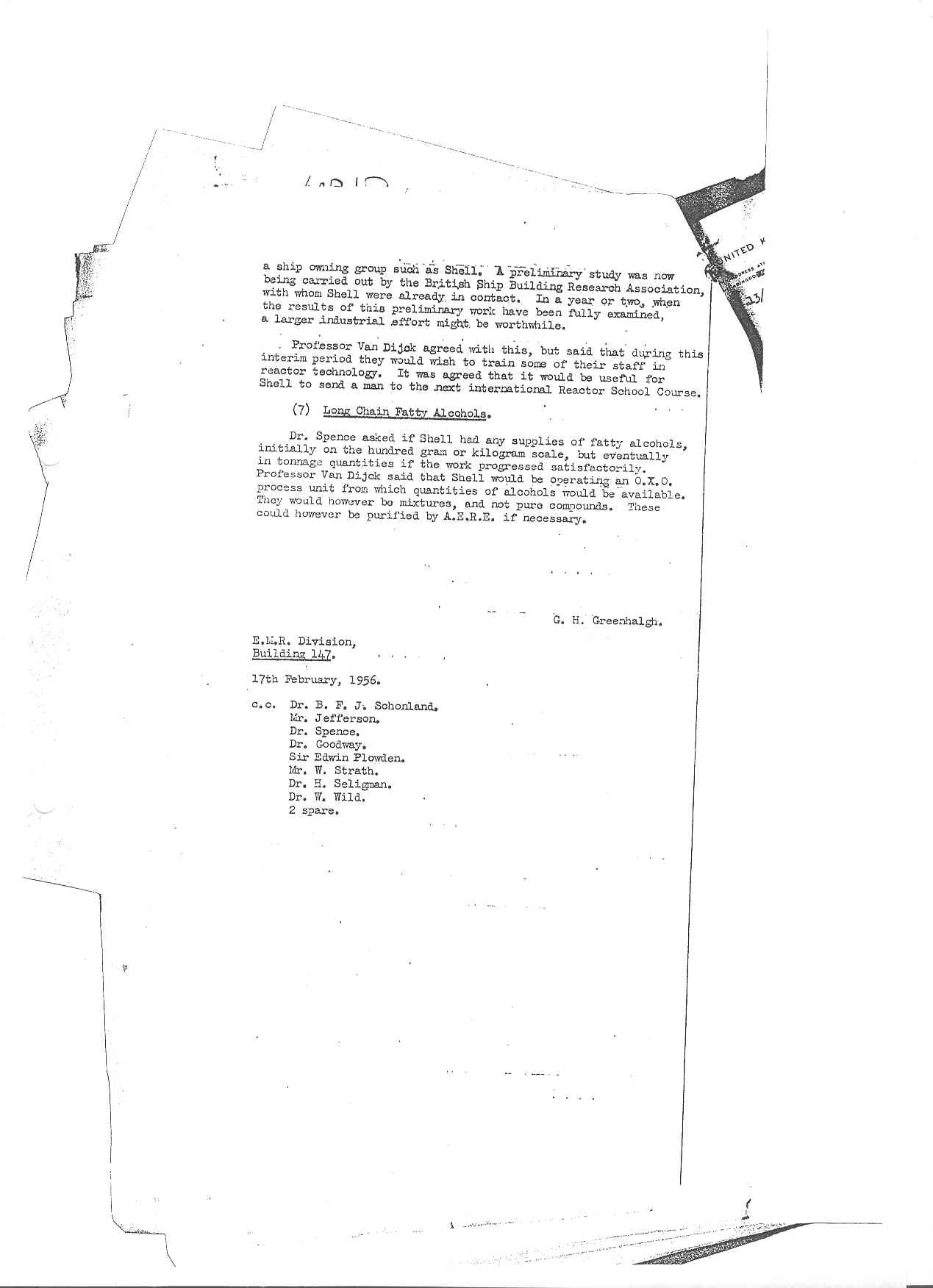
UK Atomic Energy Executive internal correspondence: 17 February 1956: Involves Chairman of UKAEE and the Chairman of Shell Transport, Sir Francis Hopwood, concerning visit to Harwell by two members of the Shell Group

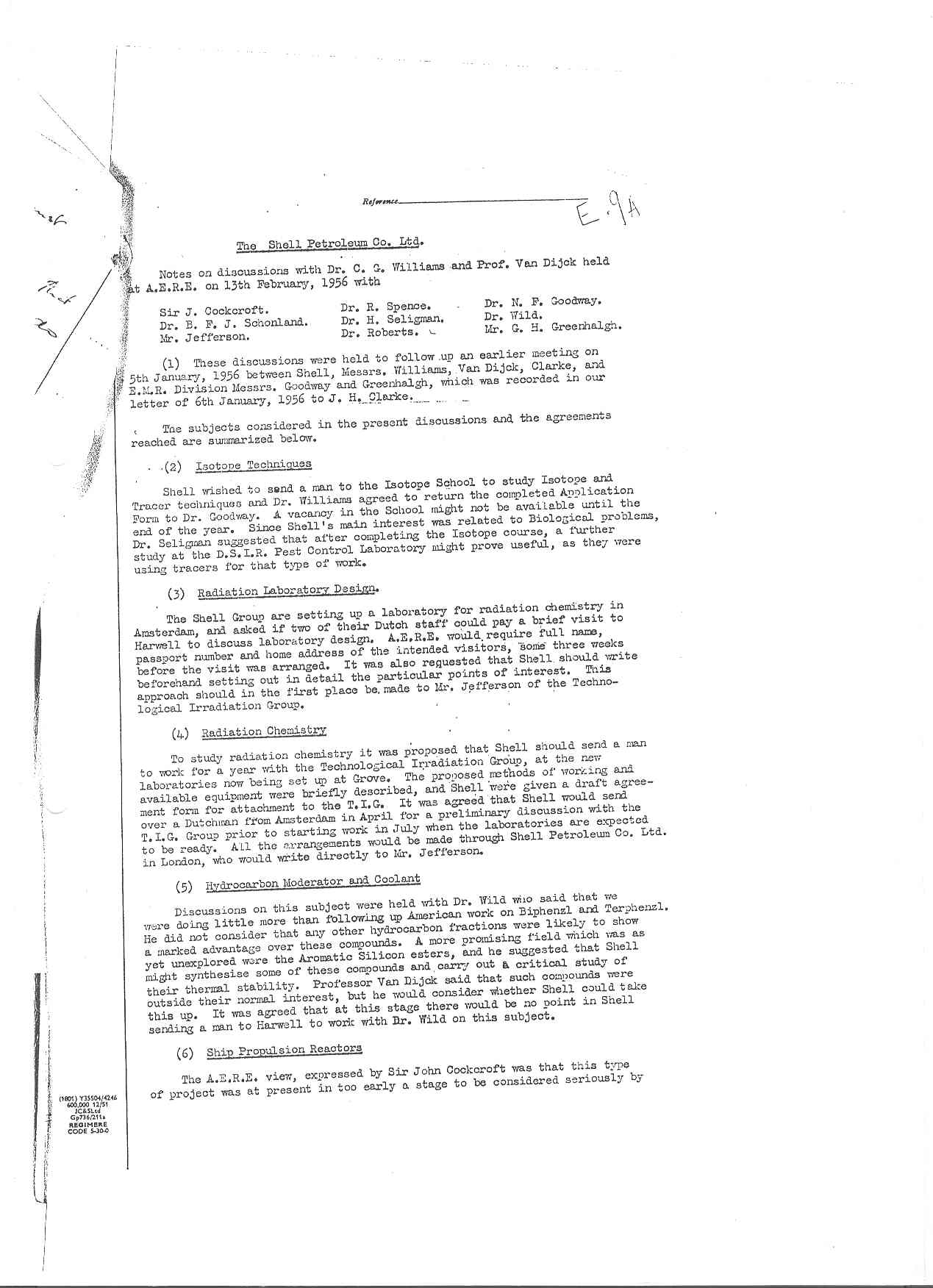
Details of discussions and agreements between The Shell Petroleum Co. Ltd and the UKAEA recorded on typewritten note dated 17 February 1956: Subjects included “Isotope Techniques”, “Radiation Laboratory Design”, “Radiation Chemistry”, “Hydrocarbon Moderator and Coolant” and “Ship Propulsion Reactors”: The Atomic Energy Research Establishment was represented in the meeting by Sir John Cockcroft, Director of the AERE. (see Page 1 & Page 2 below)

Page 1

Page 2

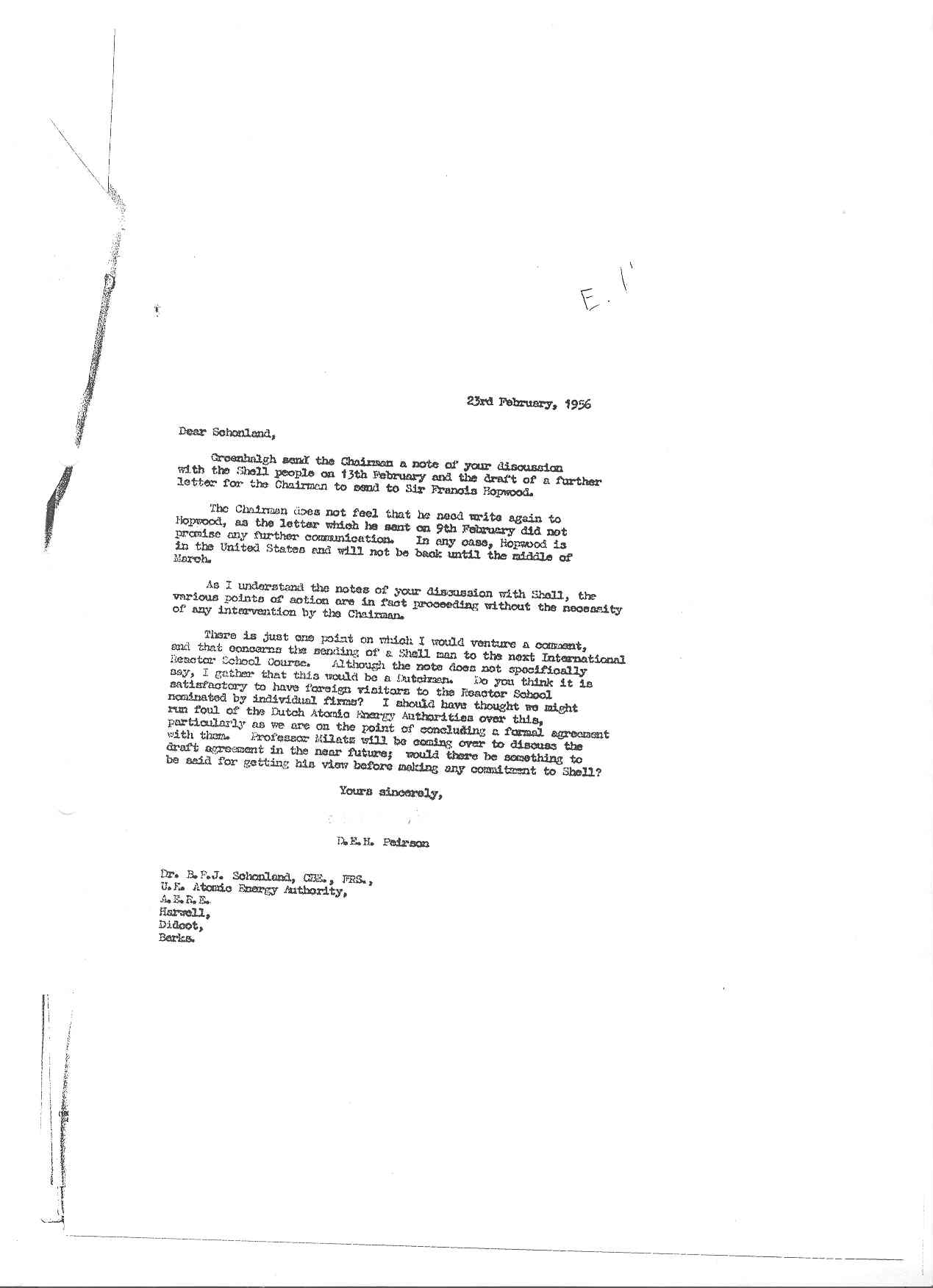
UKAEA internal letter proving further confirmation that the Chairman of the UKAEA and the then Chairman of Shell, Sir Francis Hopwood, were personally involved in the negotiations between the UKAEA and Shell: Concern expressed at the prospect of a Dutch Shell employee attending the next “International Reactor School Course”: 23 February 1956

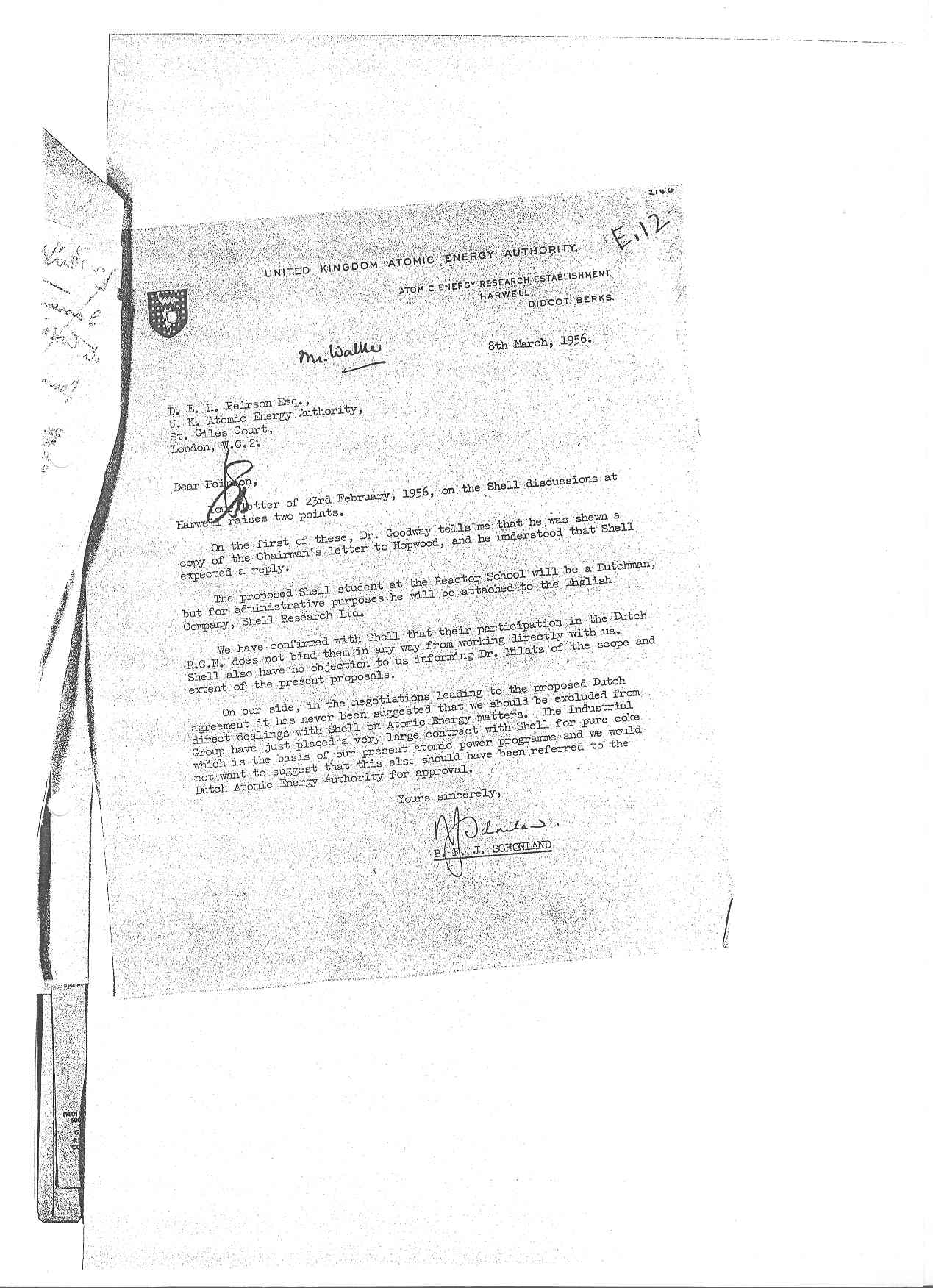
UKAEA internal letter regarding “proposed Shell student at the Reactor School will be a Dutchman…”: 8 March 1956

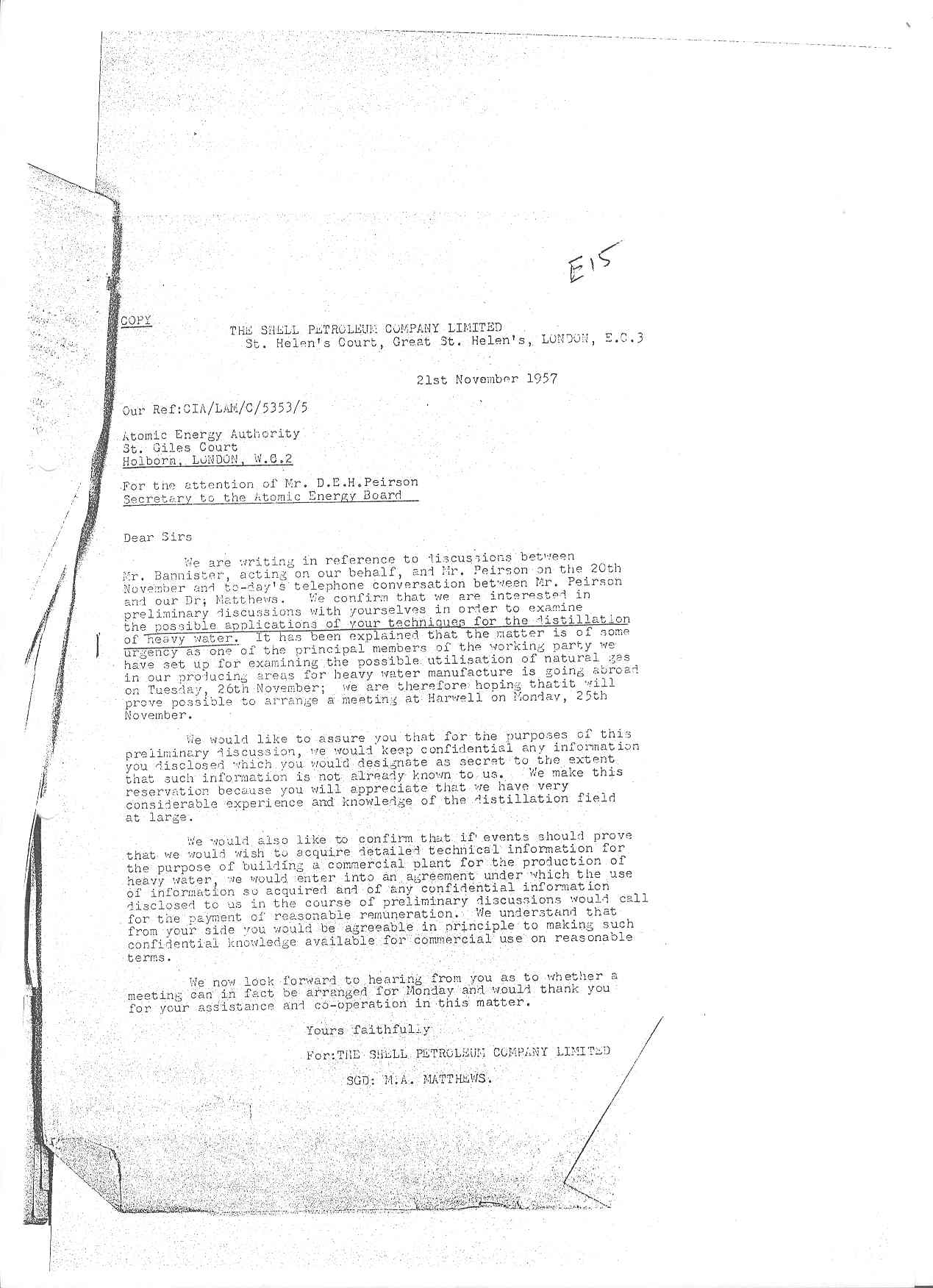
Approach letter from Shell Petroleum Company Limited to the UKAEA concerning “our wish to acquire detailed technical information for the purpose of building a commercial plant for the production of heavy water…”: 21 November 1957

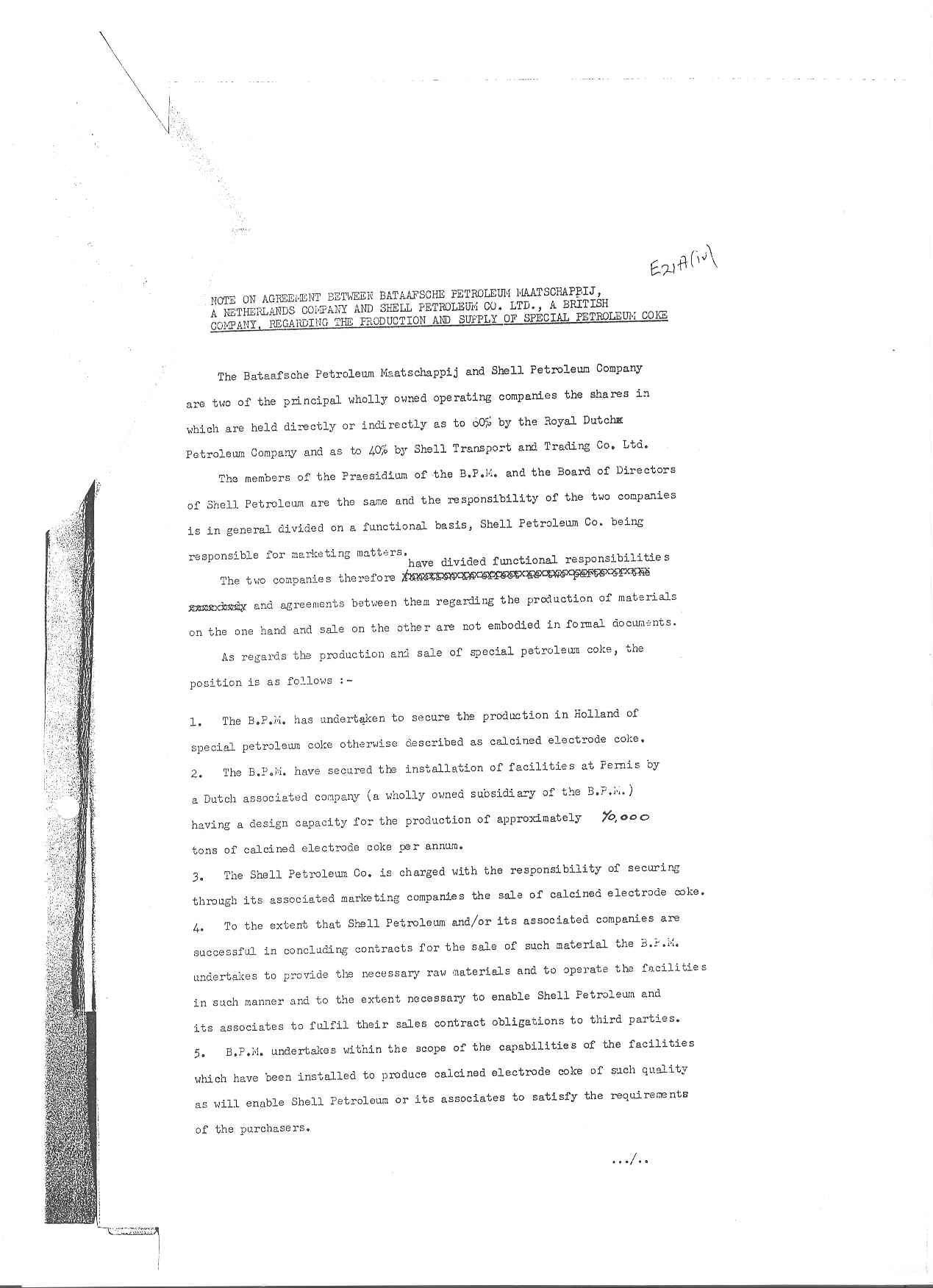
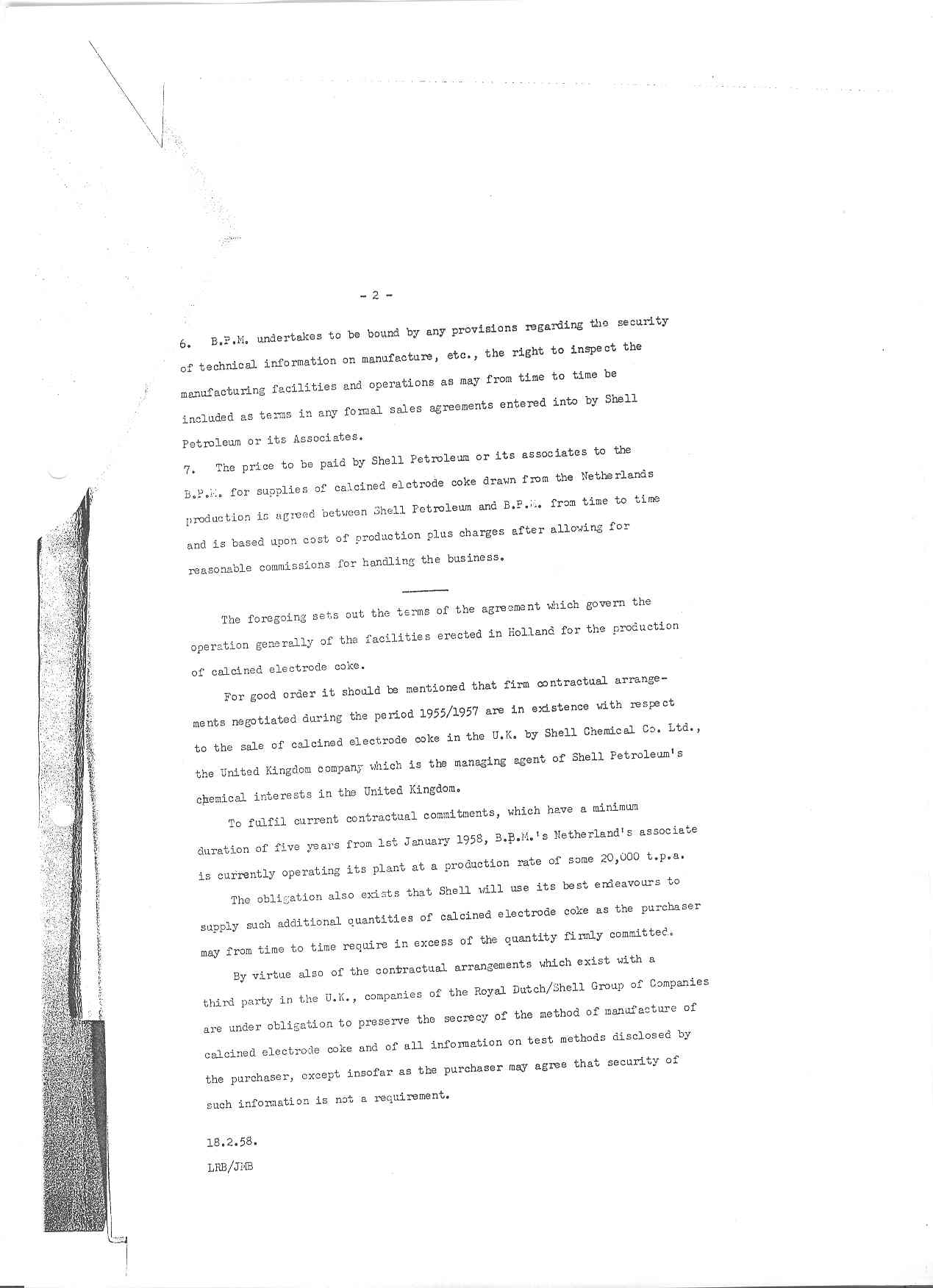
NOTE ON AGREEMENT BETWEEN BATAAFSCHE PETROLEUM MAATSCHAPPIJ AND SHELL PETROLEUM CO. LTD: Reveals there are agreements between the Dutch and UK parent companies of Shell “not embodied in formal documents”: 18 February 1958 (see Part 1 & Part 2 below)

Part 1

Part 2

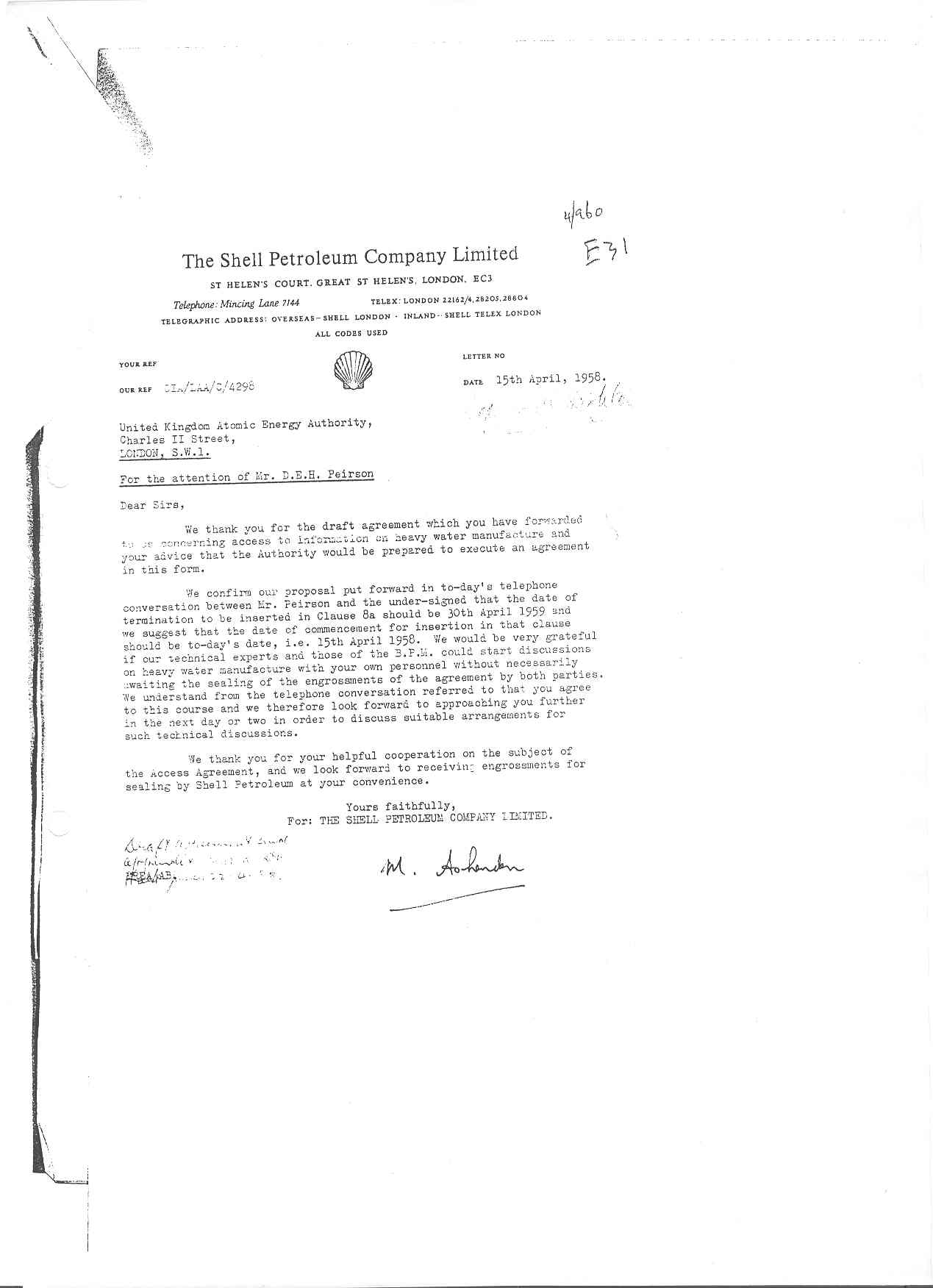
Letter from Shell International Chemical Company Limited to U.K. Atomic Energy Authority covering exchange of information on “heavy water manufacture”: 15 April 1958

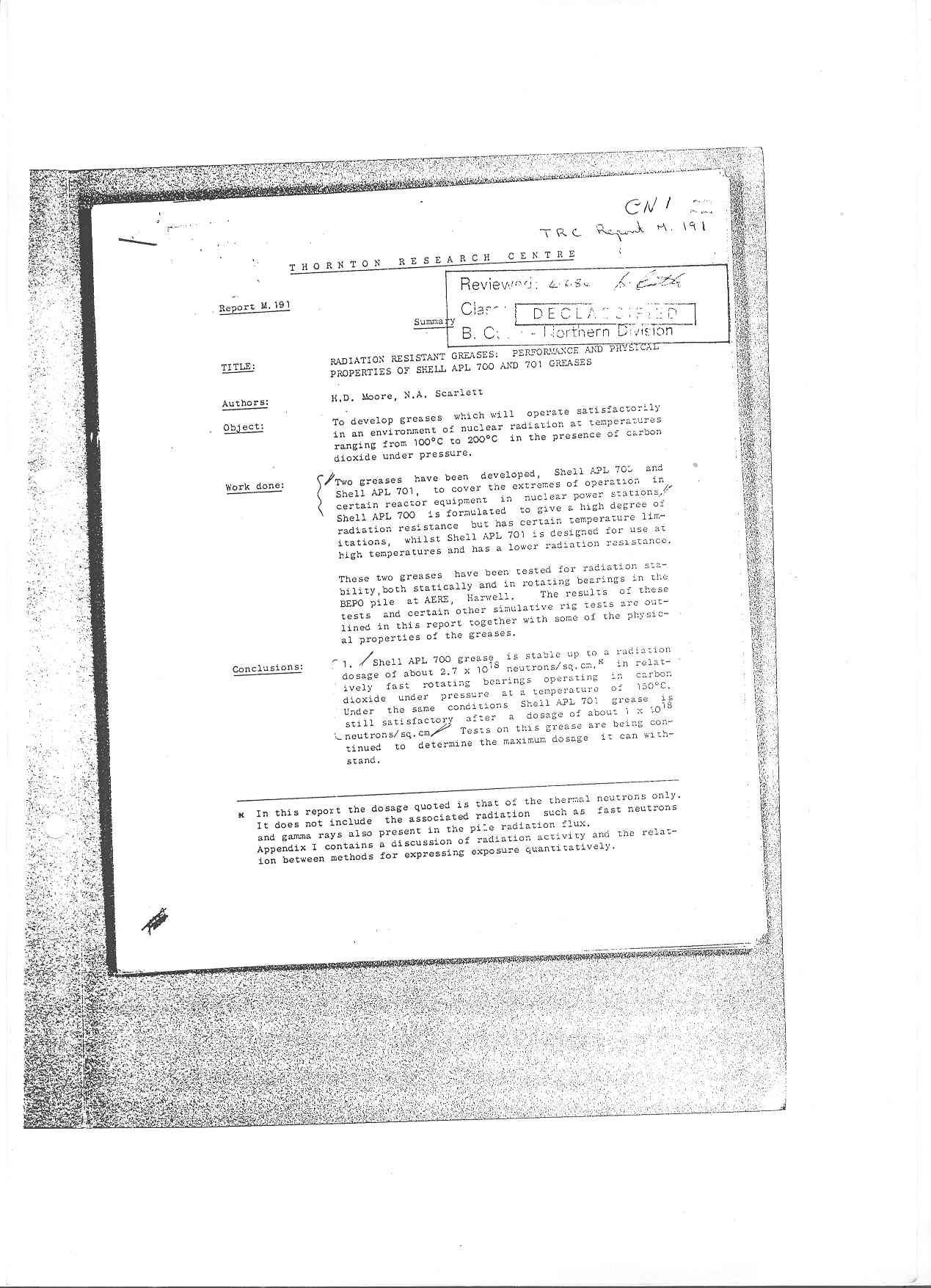
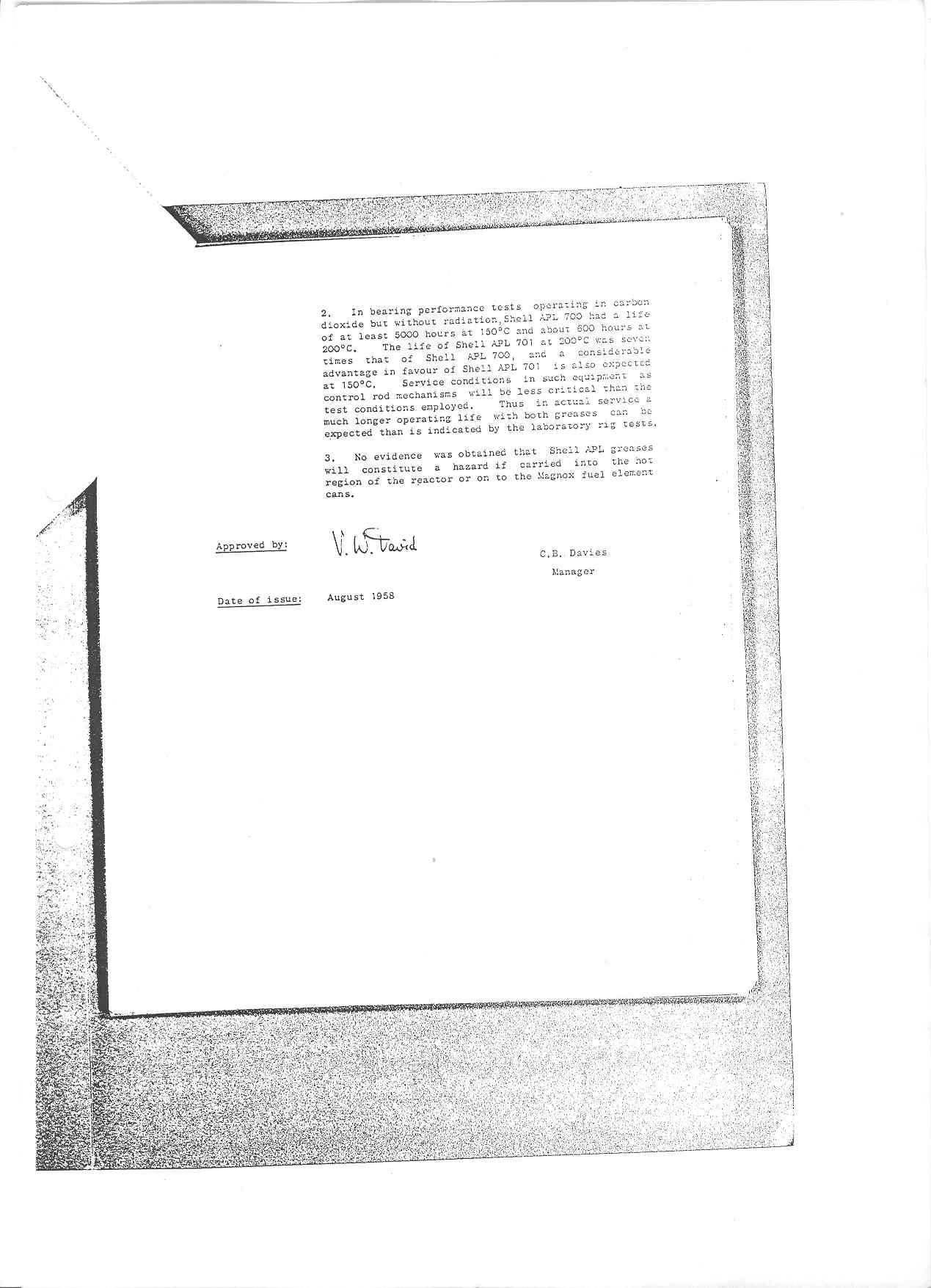
Shell Thorton Research Centre Report: August 1958: Deals with development of radiation resistant greases for reactor equipment in nuclear power stations (see Page 1 & Page 2 below)

Page 1

Page 2

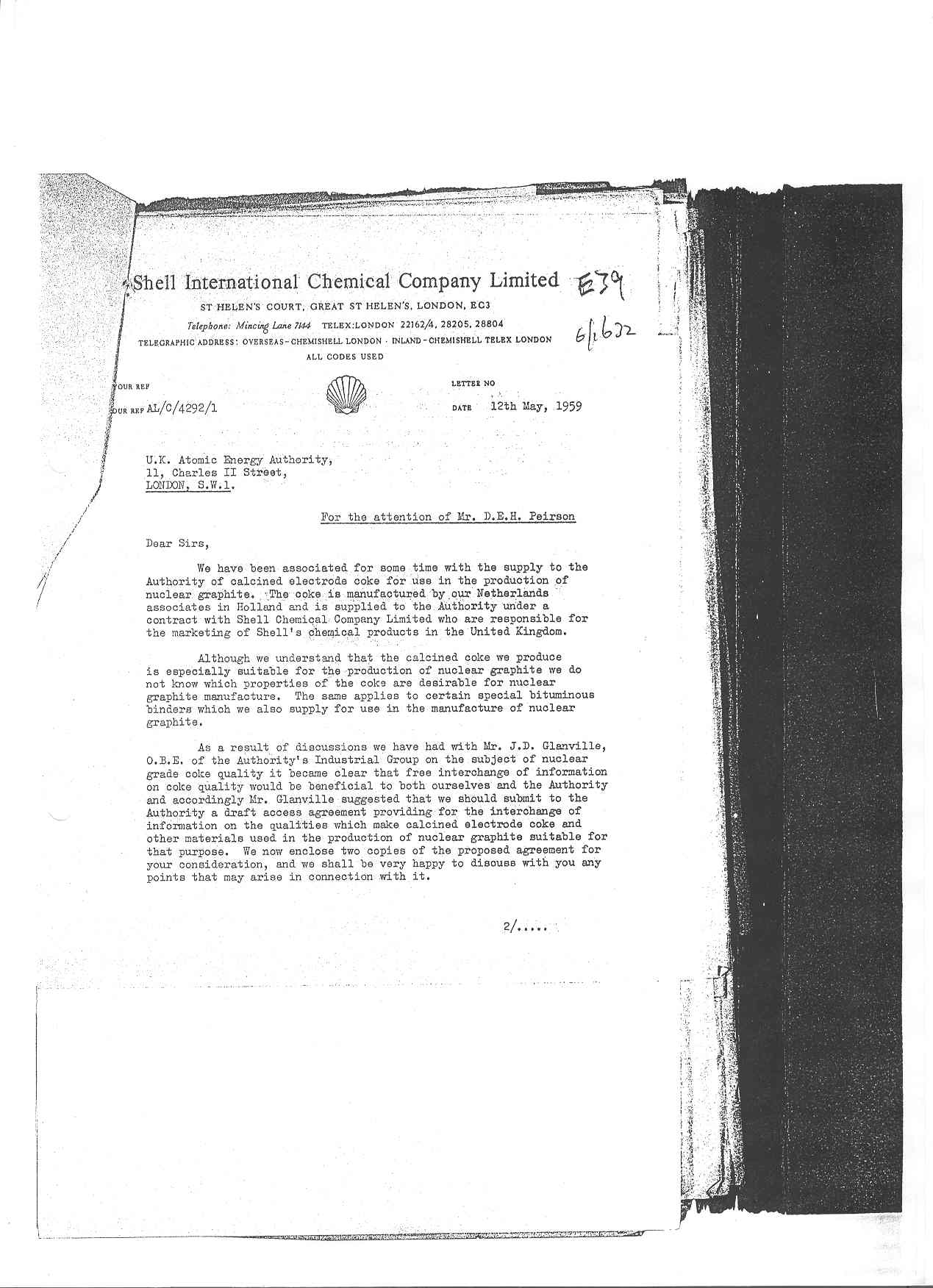
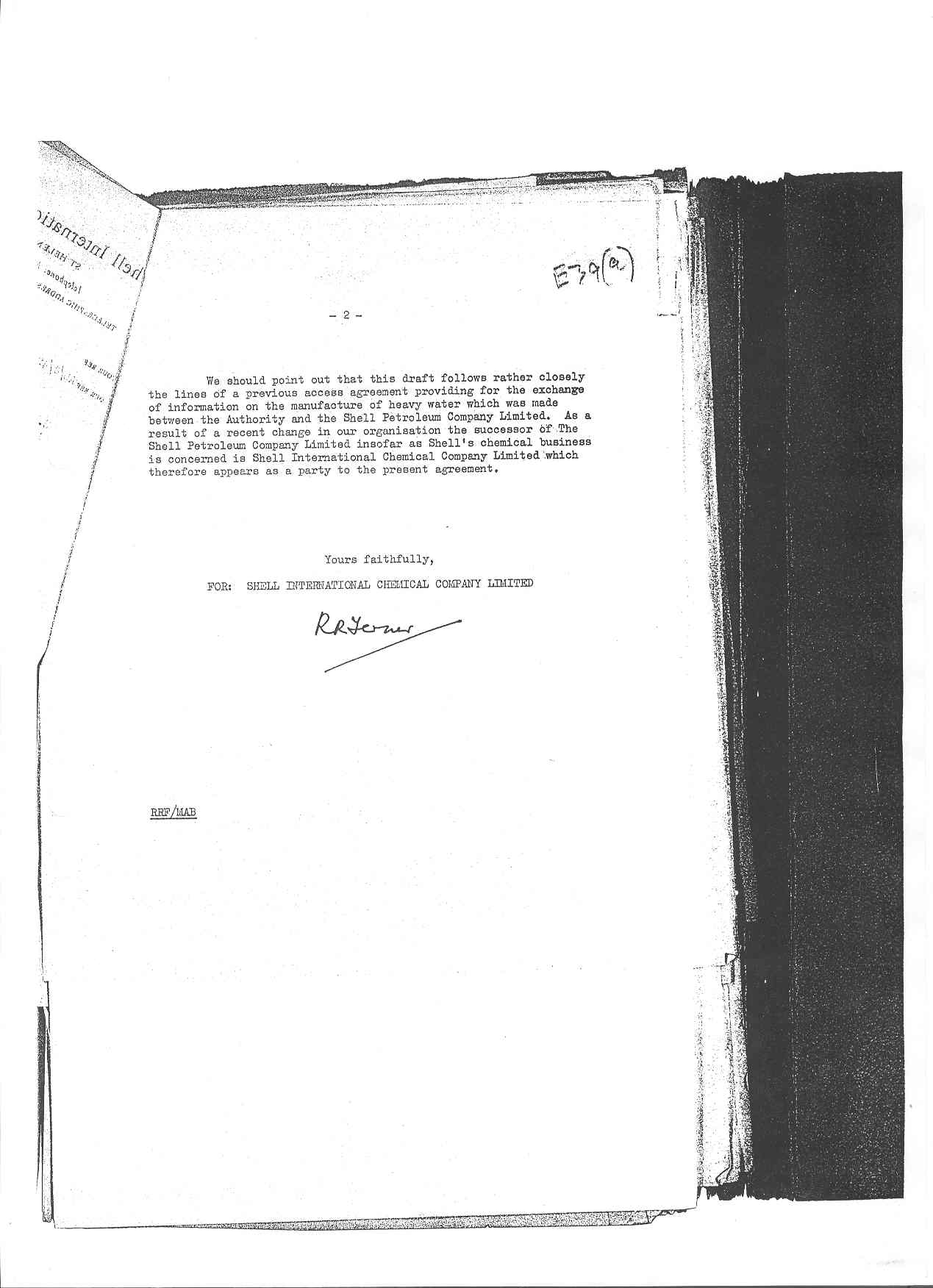
Approach letter from Shell International Chemical Company Limited to U.K. Atomic Energy Authority covering exchange of information on “heavy water”: 12 May 1959 (see Page 1 & Page 2 below)

Page 1

Page 2

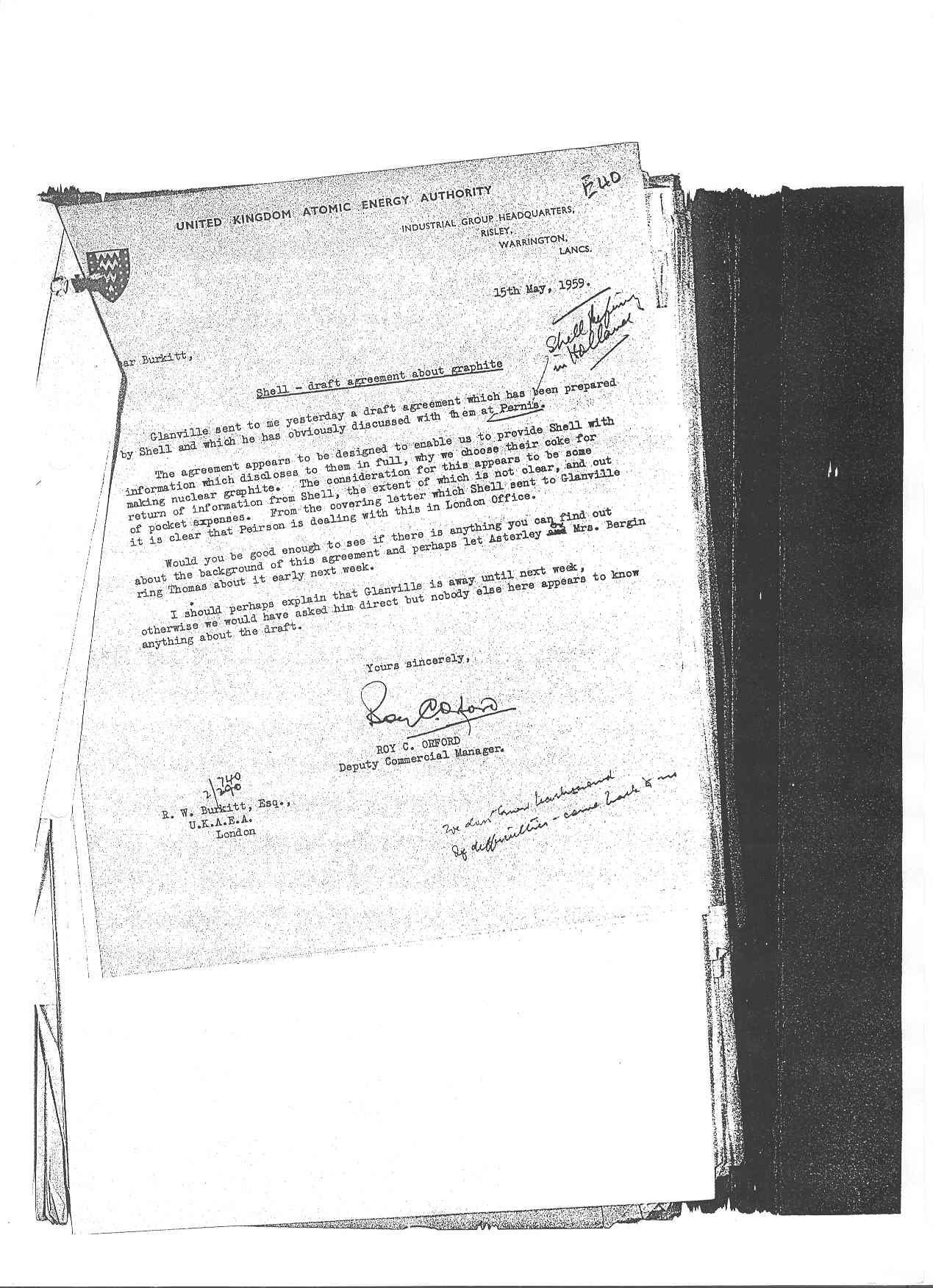
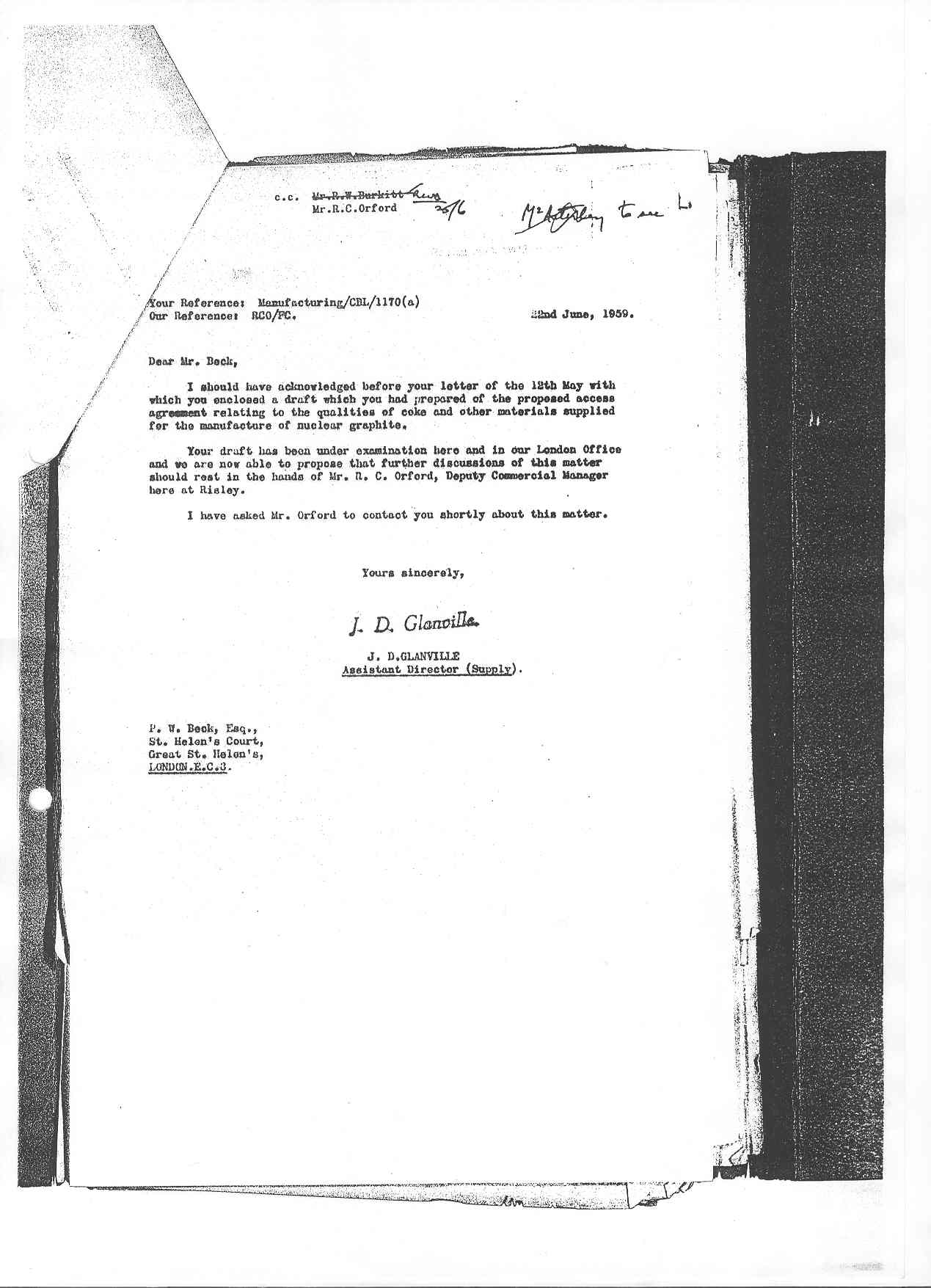
UKAEA internal letter headed “Shell – draft agreement about graphite mentions “making nuclear graphite”: 15 May 1959

UKAEA internal letter discusses “heavy water access agreement” already concluded: 22 May 1959

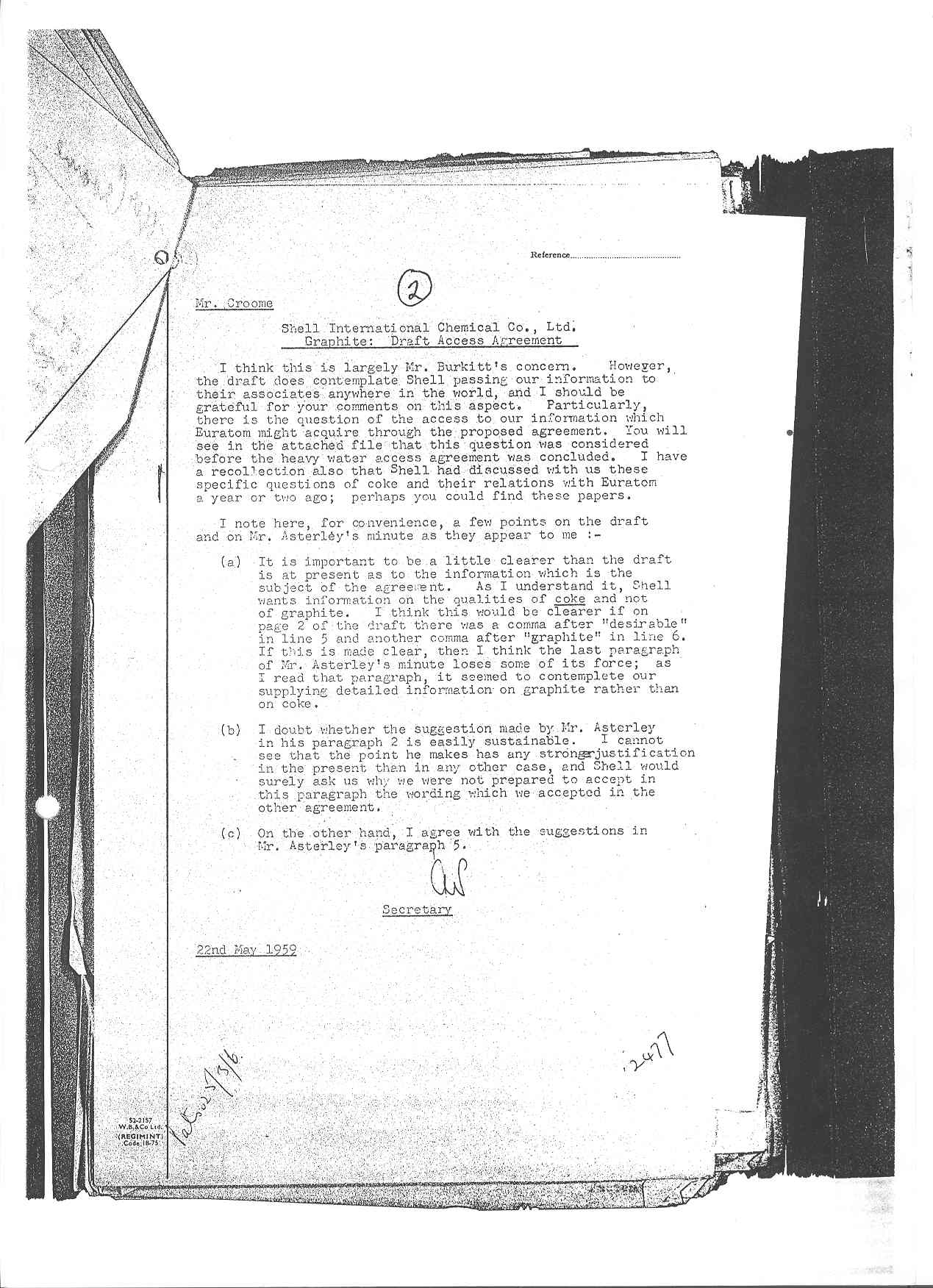
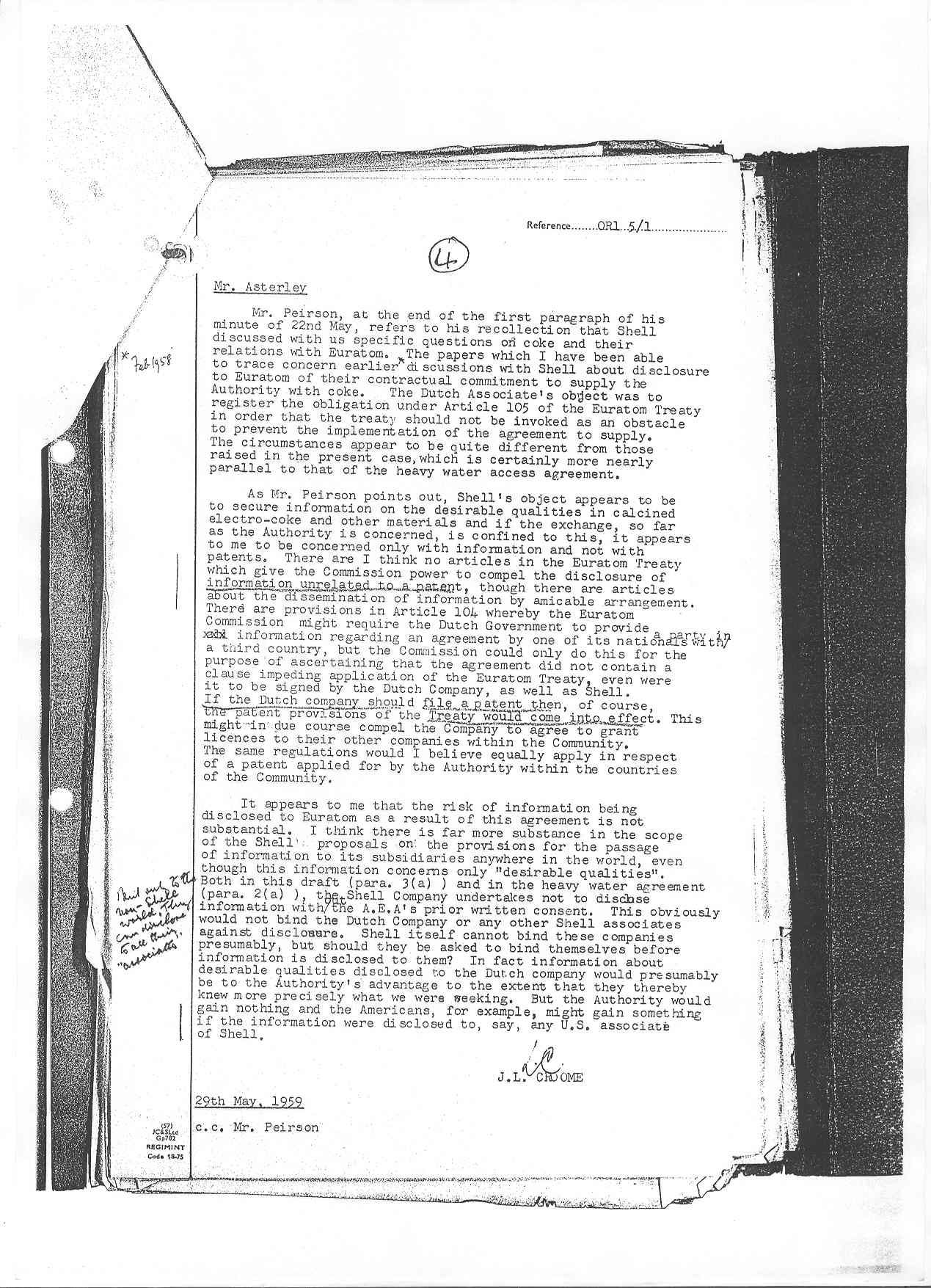
UKAEA internal letter expressing concern about information arising from a proposed Graphite Access Agreement being passed by Shell International Chemical Co Ltd to their associates, in particular Dutch associate company: 29 May 1959

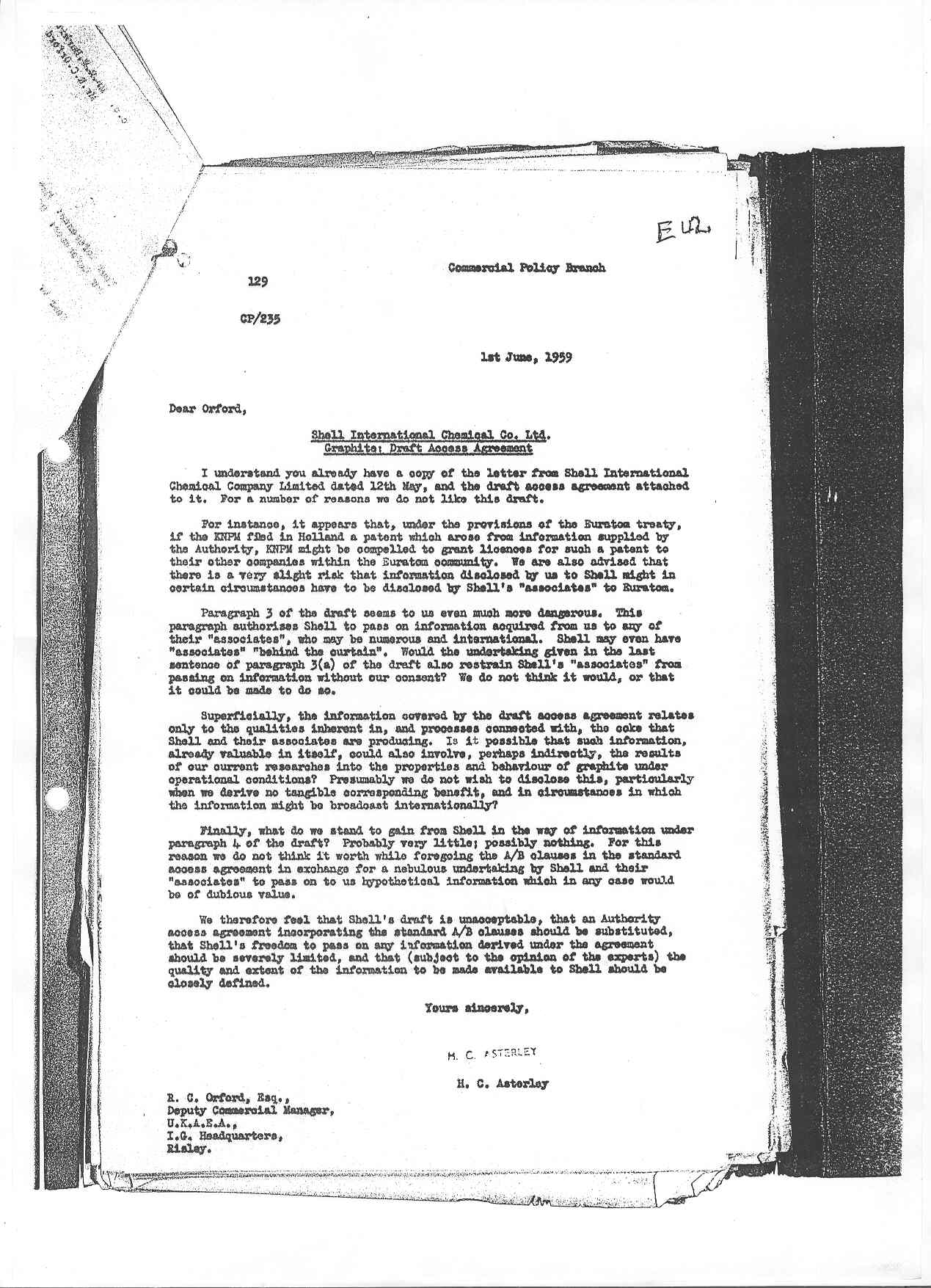
UKAEA internal letter expressing concern about information arising from a proposed Graphite Access Agreement being passed by Shell International Chemical Co Ltd to their “associates, who may be numerous and international”: 1 June 1959

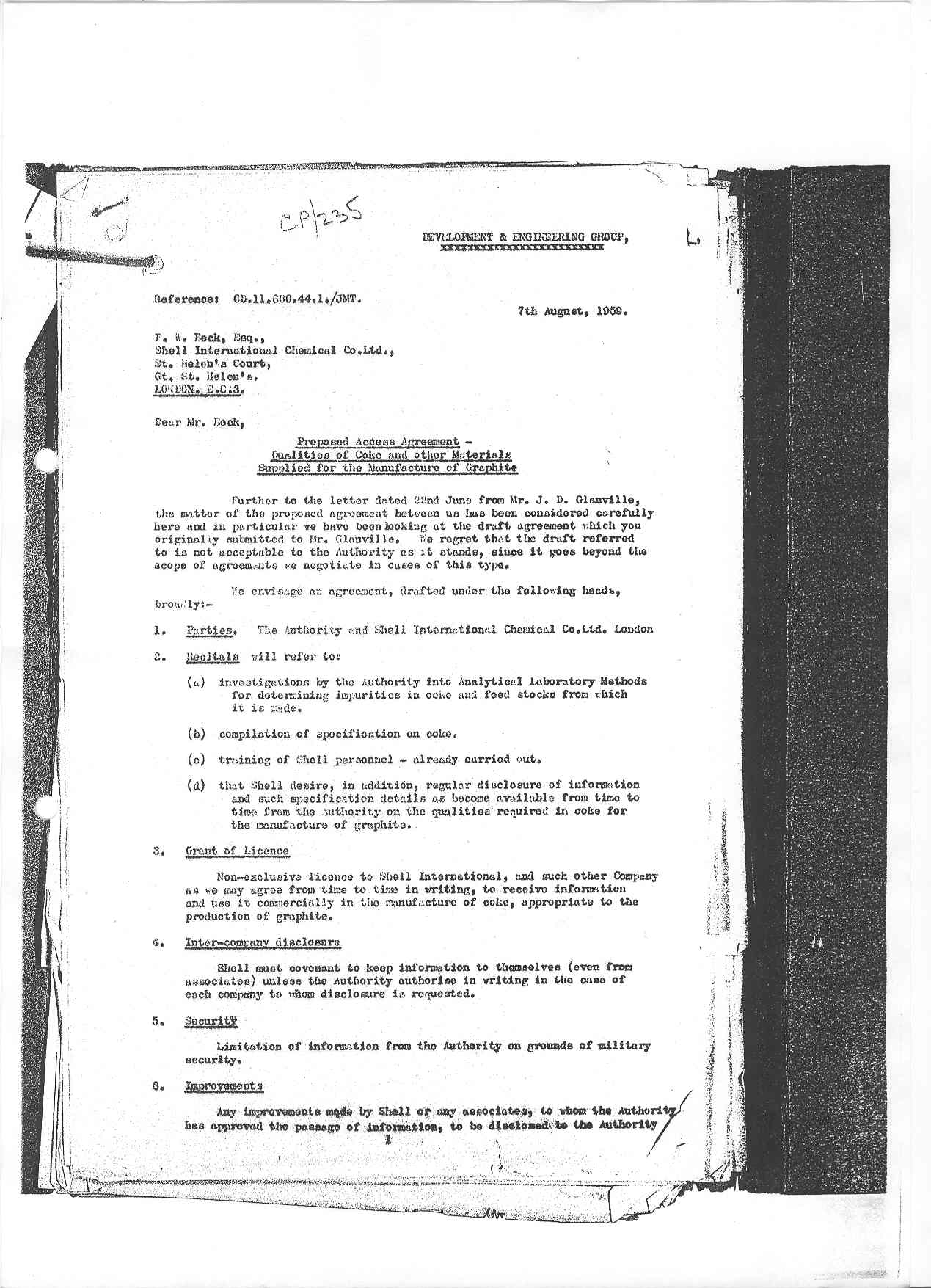
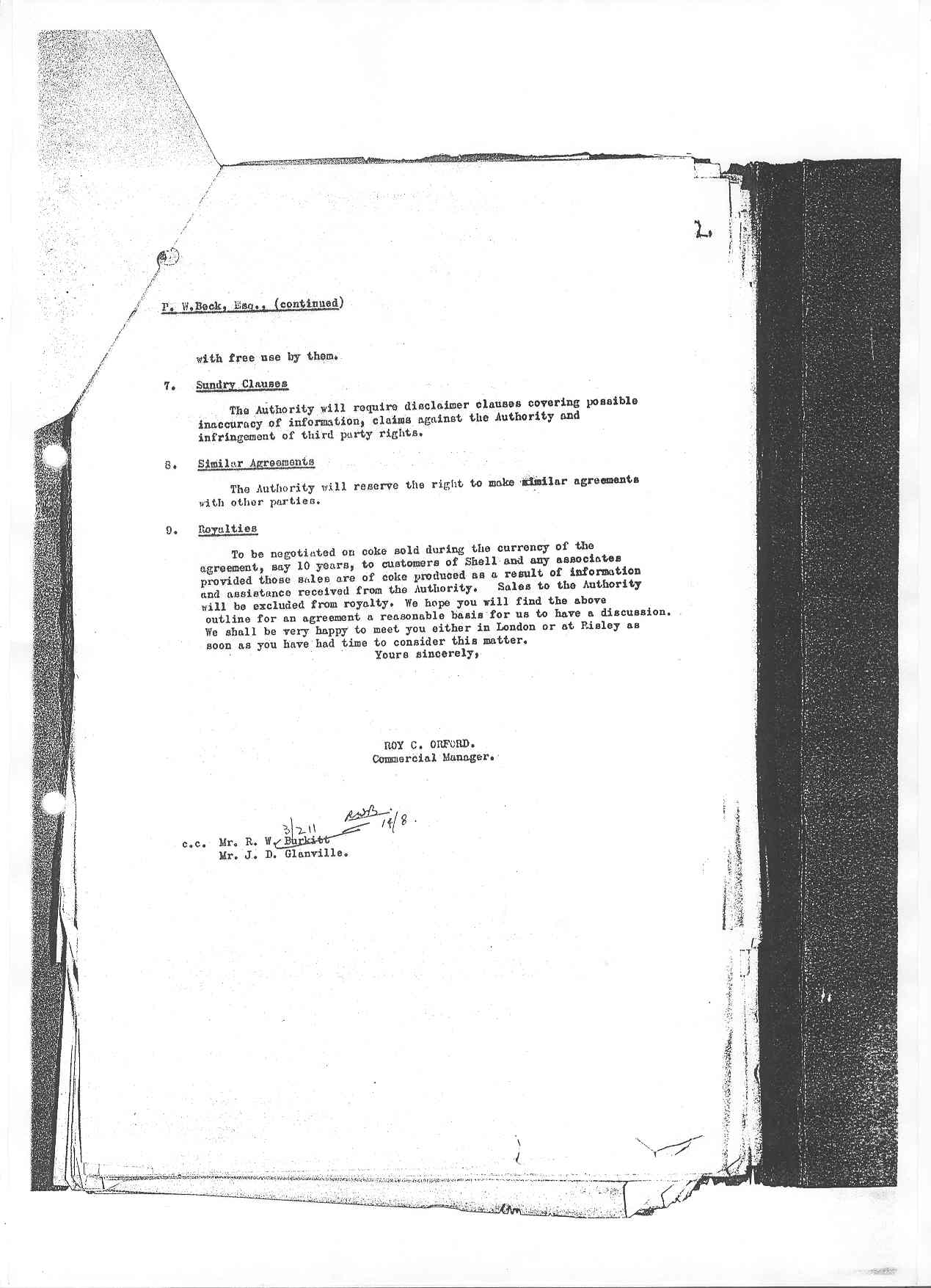
Letter from UKAEA to Shell International: Proposed Access Agreement regarding Manufacture of Graphite: 6 August 1959

Page 1

Page 2

Page 3

Declassifed docs webpage

Extracts from “A CENTURY OF OIL” published in 1997: Extract from page 247 in reference to the Shell Thornton Research facility near Liverpool:

Extracts from “A CENTURY OF OIL” published in 1997:

Extract from page 247 in reference to the Shell Thornton Research facility near Liverpool:

Thornton’s most unusual venture at this time was into radioactivity. This took two forms: the use of radioactive isotopes to monitor wear on piston rings in car engines, and the provision of lubricants for atomic reactors. The latter came about almost by chance, when samples of oil were subjected to radiation from Cobalt-60 to see the effect on the hydrocarbons. What was discovered was that one sample proved impervious to radiation, remaining liquid throughout the experiment. As it happened, a nuclear reactor was being built at Calder Hall in Cumbria, barely 90 miles from Thornton. Lubricating the reactor’s graphite moderators was a problem no one had yet satisfactorily answered, but Thornton’s fortuitous find was the basis of the solution.

Extracts from “A CENTURY OF OIL” published in 1997:

Extracts from pages 311 and 312

The venture into nuclear energy was even less successful – indeed, considerably less so. In the 1950s, when nuclear power began to generate electricity for civilian use, Shell was delighted (as we saw in chapter 13) to gain the contract to supply all the lubricants used in Calder Hall, Britain’s first commercial nuclear power station, and proceeded additionally to produce coke of extremely high purity for use in reactors. At the time there was a good deal of concern among shareholders that nuclear power could become a competitor to oil. Lord Godber (Shell Transport’s then chairman) dismissed these fears as exaggerated, but a watchful eye was kept on the nuclear industry’s development. On 2 April 1958, Shell Transport’s Minute Book recorded that ‘A paper on Atomic Power was placed before the Board and was the subject of a general discussion.’ Less than a year later, on 16 March 1959, John Berkin one of Shell Transport’s directors – reviewed for the benefit of his colleagues on the board a ‘Memo on Atomic Power …with particular reference to its cost compared with that of power from conventional fuels.’ The wisdom then was the same: there was no foreseeable likelihood of nuclear power even coming close to overtaking oil as a cheap and convenient source of energy. But by the early 1970s that view had changed. A toe was put in the nuclear water with the purchase of a 10% interest in a Dutch company called Ultra-Centrifuge Nederland, part of a British-Dutch-German arrangement for developing the centrifuge method of uranium enrichment; and in 1973 Shell announced its ‘first big step into nuclear energy’. In a 50:50 partnership with Gulf Oil, two businesses – General Atomic Company in the United States, and General Atomic International elsewhere – were established to develop, manufacture and market the second-generation High Temperature Gas-cooled Reactors (HTGRs) and their fuels.

The initial cost to Shell was $200 million, with all subsequent costs to be shared equally with Gulf. For its money Shell acquired interests in a small 40-megawatt experimental plant in Peach-Bottom, Pennsylvania; a commercial-scale 330-megawatt plant in Colorado; six other larger HTGRs which were on order; and two more on which options had been taken. Nor was that all. HTGR technology was set to be introduced into France and West Germany, and possibly into the UK and Japan; and (as Shell Transport’s annual report for 1973 recorded) General Atomic was already working on several other developments, including inter alia an HTGR closed-cycle gas-turbine power plant, a gas-cooled fast breeder reactor, the use of HTGR heat in industry, nuclear fusion research and ‘the construction of the largest industrial light-water reactor fuel reprocessing plant in the United States.’

In the annual report there was, with all this, a blissful lack of technical explanation, even in the simplest terms. Probably few shareholders had any clear idea of the differences between types of reactors, or between nuclear fusion and nuclear fission as sources of power; but an annual report is hardly the place to attempt such explanations, and anyway – 0 brave new world! – they may not have wished for elucidation. Especially when set against the worrying and unfamiliar background of high-cost oil, it was enough to feel that their company was, as always, in the vanguard of modern energy supply.

At any time in our lives, we all (or most of us) do the best we can with the knowledge and tools currently available, and to many specialists and non-specialists alike, Shell’s entry into the nuclear field seemed a sensible idea. Proponents of nuclear power saw it as the clean, simple, eternally renewable fuel ofthe future, and nuclear fusion (the process at work in the sun) may yet prove to be just that. But the existing method of nuclear power generation (nuclear fission, the principle of the atomic bomb) was already a publicly contentious issue, soon exemplified – long before the much greater disaster at the Russian plant of Chernobyl in 1986 – by the episode at Three Mile Island near Harrisburg, Pennsylvania, when, on 28 March 1979, the cooling system of the plant’s No.2 reactor failed and led to a leak and partial melt-down of the uranium core, with radiation detectable over twenty miles away.

Three Mile Island was a great leap backwards for the nascent nuclear industry, hardening feelings that having a nuclear reactor on one’s doorstep might not be an unmitigated good. It was followed, moreover, by a ,series of five smaller but similar accidents in the US, which led the Nuclear Regulatory Commission temporarily to cease licensing the construction of new reactors.

Although General Atomic was not involved in any of these, Shell read them as a clear warning and decided there was not enough to be gained from remaining in an industry which was so expensive, so politically vulnerable, and so much the target of public protest. Those factors were quite sufficiently present in the oil industry anyway; one would have to be a glutton for punishment to seek them elsewhere as well. So, resolving to remove itself from active participation in the nuclear industry, Shell sold its interests in both General Atomic companies to Gulf Oil in 1980. Lasting a mere seven years, nuclear energy had been a short and costly byway – one which Shell would not follow again for a very long time, if ever.

A colour photograph on page 312 had the caption: In appearance oddly reminiscent of Shell’s pecten logo, the Doublet III experimental nuclear fusion device was developed by General Atomic.


ARTICLES RELATING TO ALLEGED RADIATION POISONING OF RAY FOX BY SHELL

ARTICLES RELATING TO ALLEGED RADIATION POISONING OF RAY FOX BY SHELL

ContractJournal.com article 29 July 1998  Extract: On 19 June 1998 a meeting involving Wokingham District Council, the Environment Agency, the Health and Safety Executive, Berkshire Health Authority, Thames Water and the Medical Toxology Unit from Guy’s and St. Thomas’ NHS Hospital Trust concluded that there was no evidence to support the claim that contamination had caused ill health for one particular individual, Mr Fox.

The Sunday Times: Suburb ‘poisoned’ by plutonium: 8 July 2001  Extract: Some of the highest levels of plutonium and uranium contamination recorded in Britain have been found in a home in a suburb in southeast England. Soil and dust collected from the Reading suburb of Earley gave readings of at least 100 times the normal background level of radiation.Shell UK said last week “no nuclear material was ever stored or processed” at Earley.Dr Michael Clark, of the NRPB, said: “These are levels sometimes found near nuclear installations, so it is very surprising to find them in a house in Reading.” He said the NRPB would investigate.

Radioactive Times: Vol.5 No1. “A Reactor at the Bottom of the Garden”:  Extract: In the course of investigating this strange story, we have now found that there was indeed an experimental nuclear reactor beneath the ground at the Earley depot. It was visited by Dr David Greenwood who worked at University College London and who recently came to Wales to talk with Chris Busby and others interested in the case. Dr Greenwood has sent an affidavit to the European Commission describing the underground laboratory. The reactor was a graphite moderated reactor of about 30 feet diameter buried several metres deep. It was used for nuclear research in connection with the Manhattan Project and later nuclear developments. Greenwood named several eminent scientists who knew of the existence of the reactor, including Prof David Bohm, the Nobel laureate. He explained that the radioactive contamination which was being produced by the research there was affecting the special oils he went there to obtain for his high vacuum mass spectrometry research.

INDYMEDIA UK: TESTS IN POISONED BERKSHIRE SUBURB: 2 January 2002 Extracts: The owner of the 4 bedroom property, Ray Fox, is aware that his debilitating and life threatening illnesses are due to the fact that the house is radioactive. Earlier investigations have already found extremely high levels of uranium and plutonium. Because of the chemicals and radioactive materials that have leached onto Ray Fox’s land and into the house over a period of time via the adjoining rainwater drainage systems, his health has deteriorated and he is now registered disabled. The property backs onto a small housing estate built in 1997 on an old Shell petrochemical depot that was operational from the 1930s for several decades 000000

The Independent: Radioactive house is put up for sale: 14 January 2003  A property described as “the most radioactive house in Britain” is up for sale, despite unnaturally high levels of plutonium in its garden.

Green Party Website: Government told to come clean on secret nuclear facility: 21 March 2003  Extract: At its twice-yearly conference, held in Llandrindod Wells from 13 – 16 March, the party unanimously passed a resolution insisting on a complete clean up of the nuclear facility at the former Shell site in Earley, south east of Reading, and immediate action to ensure that victims receive medical attention.

Corporate Watch Newsletter 14 : SHELL SHOCKER: July/August 2003  Extracts: Shell was unable to say how many reactors it once operated, where any of them were located, or when and how they were disposed of. “It was a long time ago” said a Shell spokeswoman.

Raymond Fox, the owner of the house, became dangerously ill in the mid 1990’s, investigating suspected pollution in his garden. He found a drain leading off the oil depot and into his garden where it intersected with a rain water drain. When he entered the drain he came into contact with oily sludge that caused him to become critically ill. He suffered agonising pains, convulsions and blackouts, his feet would bleed, and his hair fell out in clumps. Now, after years of investigation, his house is at the centre of what must be one of the worst nuclear scandals in British history.

Stephen Kaiser of the European Commission is now investigating the case. He has met with British government representatives who are not denying the contamination of Fox’s land, instead they claim that the radioactivity in Ray’s garden is simply the result of fallout from weapons testing, concentrated by heavy rainfall.

Corporate Watch has learned that a barrister, the late Derek Willmott, had also been investigating the Earley case, on behalf of clients who claimed to have been made ill as a result of pollution originating in the old Shell site. Willmott’s report alleges that the old Shell depot, on which Amber Close is now built, concealed a subterranean facility which housed a nuclear test reactor. His report is based in part on testimony from Dr David Geenwood, a scientist from the medical physics department of University College Hospital, London, who used to visit the site regularly during the 1960s and 70s, to purchase ‘special oils’ for use in mass spectrometers. It was during this time that Greenwood and two other scientists were invited to conduct an inspection of the complex. Greenwood has testified that a graphite test reactor was installed in a large lead-lined chamber along with a neutron generator and large quantities of plutonium, uranium, cobalt 60, and other radioactive substances.

Shell categorically denies that there was a reactor or any other nuclear materials at the Earley site. “Shell is an oil company,” said spokesman Justin Everard. This is disingenuous. It is not common knowledge, but Shell did once have nuclear power interests: General Atomic (in the USA) and General Atomic International (elsewhere): joint ventures with Gulf Oil that operated between 1973 and 1982.

In April 98, Josef Kees, the German doctor who treated Ray Fox, wrote to Dr Abid outlining his analysis of Fox’s condition and urging him to ensure that Fox received treatment. Dr Kees diagnosed “definite toxic allergic reaction resulting from a mixture of toxic substances… a severe toxic poisoning… [including, inter alia] lindane, uranium, DDT and DDE,” and commented, “this demands actions to prove the contamination and then decontaminate the land around his house and the surrounding area.” He made recommendations for treatment and further testing. Despite Fox’s requests to the medical authorities, none of these tests or treatments have yet been conducted.

BANKRUPTCY In addition to being stonewalled by the local council, and medical authorities, Raymond Fox has also fallen victim to a highly dubious bankruptcy proceeding. His company, Fox Building, went into receivership in January 1997, when his illness had rendered him unable to work. Then in 2001 Ray was made personally bankrupt over an alleged personal guarantee for one of Fox Building’s debts. Ray maintains that the guarantee produced at his bankruptcy hearing was a forgery. He even offered to pay the debt in 1999 in order to be rid of the unwanted hassle. His offer was turned down, essentially forcing him into bankruptcy.

Daily Telegraph: Exclusion zone: 29 November 2003: Raymond Fox claims that radioactivity at his former home has blighted his health – so he refuses to return. His neighbours and the local council insist that the area is perfectly safe.

David Rowan investigates a suburban mystery… Extract : At first, he thought the radioactivity might be connected with the nearby atomic weapons plant at Aldermaston; or perhaps the result of a hushed-up air crash involving a damaged nuclear weapon. But since he discovered toxic black sludge in drains leading from the former Shell depot next door, Mr Fox has drawn a conclusion which, if true, has far more worrying implications for his neighbours. Somewhere beneath the bottom of his garden, he is convinced, there was once – perhaps still is – a secret nuclear bunker.

Daily Telegraph: Mysterious radiation in Reading